



Migration is an extremely relevant topic today in many countries around the world. Some people emphasize its benefits — that newcomers help fill labor shortages, study, work, and pay taxes. Others, by contrast, feel irritation or anxiety: “there are too many of them”, “they are changing our culture”, “it is impossible to find a decent job”.
Perhaps everyone is right in their own way. But it is still worth asking why the same phenomenon provokes such different reactions. A paradoxical situation is quite common: even without any personal negative experience with migrants, we may still feel heightened tension or even fear toward them.
If we look more deeply, it becomes clear that the issue is not only — and often not mainly — about migrants themselves. Basic psychological mechanisms come into play here, mechanisms that helped us survive for centuries. But sometimes they begin to work against us. We automatically divide people into “our own” and “outsiders”, become wary when things change, and try to explain the tension we feel.
In this article, we will look not at politics but at psychology: where the feeling of “otherness” comes from, why it is so persistent, and what can be done about it...
“Us” and “Them” — an Automatic Setting of the Brain
 At first glance, it may seem that attitudes toward “outsiders” are shaped entirely by upbringing, culture, or political views. Yet psychological research shows that this process begins much earlier. From the very first seconds, our brain tries to determine who is in front of us: one of “us” or one of “them”. This tendency is deeply rooted in us and happens automatically.
This mechanism did not arise by accident. For most of human history, people lived in small groups. Members of the same community helped one another obtain food, protect themselves from danger, and raise children. A stranger could turn out to be either a friend or a source of threat. So the brain developed a simple rule: first be cautious, and only then decide how much the newcomer can be trusted.
Interestingly, major differences are not required for people to divide themselves into “us” and “them”. In studies by Henri Tajfel and his colleagues in 1970–1971, schoolchildren were divided into two artificial groups on the basis of completely trivial distinctions. In one version, participants estimated the number of dots on a screen and were then told that they belonged to a group that supposedly “overestimated” or “underestimated” the number. In another version, the division was based on an alleged preference for paintings by Paul Klee or Wassily Kandinsky. The participants did not know the members of their own group, had never communicated with them, and shared no common history.
They were then asked to distribute points or monetary rewards among anonymous participants. The result was that people more often favored members of their own arbitrary group, sometimes even preferring to increase the difference between the groups rather than maximize the overall benefit for their own group. In other words, within a very short time, participants began treating members of their own group more favorably and the other group with less trust, even though they knew perfectly well that the division was arbitrary.
It is important to understand that this natural mechanism does not mean that distrust is inherently bad. It is simply a feature of how our brain works, allowing us to adapt quickly to a social environment. Problems begin when a first impression turns into a stable stereotype and group membership becomes more important than the personal qualities of a specific individual.
Very often, attitudes toward migrants form long before any personal acquaintance. The brain first notices certain differences — language, appearance, habits, accent, cultural features — then automatically assigns a person to the category of “outsiders” and only afterward begins looking for explanations for the feeling that has already emerged. The subsequent attitude toward a migrant is then shaped less by that person than by the intensity of the anxiety and by whatever strengthens or weakens it. That is what we will discuss in the next section.
Fear of Change and Loss of Stability
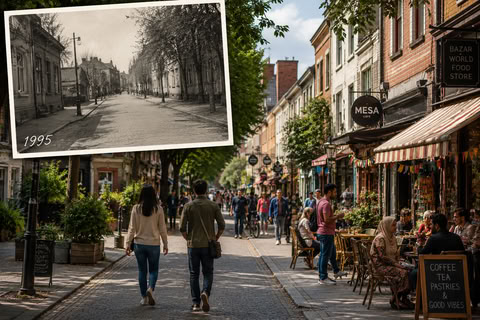 When we feel anxious about migrants, the migrants themselves are far from always the real cause. More often, the anxiety is connected with the changes that people associate with them.
Our psyche generally does not like change very much because of the uncertainty it may bring. We feel calmer in a familiar environment with understandable rules, a familiar language, established cultural norms, and predictable expectations from others. Noticeable changes require additional effort from the brain: we have to adapt, learn something new, and reconsider familiar ideas about the world. This consumes internal energy and naturally creates tension.
That is why, when a city has more people speaking other languages, when new shops, restaurants, and cultural traditions appear, or when the labor market changes, many people perceive this not as a set of separate events but as a signal: “my familiar world is changing”. This feeling may arise even when we have not personally experienced any negative consequences.
Psychology has long known that people usually react more strongly to the possibility of losing something than to the chance of gaining something new. Even when change may eventually bring benefits, the first emotional response is often caution. Our brain seems to be trying to protect us by asking a difficult question: “What if things get worse?”
In public discussions, migrants often become a symbol of future change. The actual people — with their histories, professions, families, and personalities — recede into the background. In their place appears a generalized image onto which it is easy to project one’s anxiety about the future, the economy, safety, or changes in the familiar way of life.
It is important to understand that such a reaction does not necessarily lead to hostility. It is only an initial emotional response that appears automatically. What happens next depends greatly on personal experience, contact with specific people, and the information we receive from our surroundings. But if anxiety persists for a long time, the psyche begins to look for a simple and understandable cause — someone to blame.
Why Blame Appears
 When we feel anxious, we want to understand why. Uncertainty itself is deeply uncomfortable. We try to explain what we do not understand as quickly as possible, even when the explanation is too simplistic.
For this reason, the brain begins looking for an answer to a central question: “What is making us anxious?” The psyche tries to simplify the complex picture of the world and build a clear story with an obvious cause. And once a cause seems to have been identified, it is easy to move on to a source that supposedly produced the anxiety and transfer all our negativity and fears onto it.
Imagine a city where prices are rising, housing is becoming more expensive, the labor market is changing, and pressure on infrastructure is increasing all at the same time. Dozens of factors influence these processes: changing economic conditions, natural demographic shifts, poor decisions by authorities, uncertainty in the international situation, and continuous technological development. But accepting such a complex picture is difficult. It is much easier to connect all these problems with one visible group that, in the public imagination, becomes associated with the changes.
For this reason, many different groups can become targets of blame. In different historical periods, these have included people of other nationalities, religions, professions, generations, or social classes. The mechanism changes very little — only the group onto which society projects its dissatisfaction changes.
Another psychological effect also appears. We remember information that confirms our expectations much better than information that contradicts them. If someone is convinced that a particular group causes problems, every negative incident will be treated as evidence supporting that belief. Meanwhile, numerous positive examples showing the group’s contribution to society may go unnoticed.
That is why public opinion does not always reflect reality. It often reflects the way the human psyche tries to cope with the complexity of the world. By finding an “obvious” culprit, the brain temporarily reduces internal tension even when the real solution to the problem lies somewhere else.
As a result, accusations often tell us less about the qualities of those being accused than about the state of society itself. When people feel confident about the future, the need to look for someone to blame usually decreases. But during crises, rapid change, and periods of high uncertainty, this mechanism becomes much more active.
Why Logic Does Not Work — and What Can Actually Change Attitudes
 It may seem that changing attitudes toward migrants is very simple: just show statistics, economic calculations, or research suggesting that, in the long run, a more open policy toward migrants can benefit society. In practice, however, things do not work quite that way. The reason is that such views are shaped not only by logic but also by emotions. And emotions rarely disappear simply because facts have been presented.
As already mentioned, our psyche is arranged in such a way that we involuntarily pay most attention to information that confirms our existing beliefs. If we are convinced that a certain group poses a danger, it is easy to remember one dramatic negative story while overlooking many examples that point in the opposite direction.
Interestingly, research also demonstrates the opposite pattern. One of the most effective ways to reduce prejudice against “outsiders” is ordinary human contact. When migrants stop being an abstract group and become a neighbor, colleague, doctor, teacher, or the parent of a child’s classmate, the brain begins to perceive them not as a faceless category but as specific individuals.
This does not mean that concerns automatically disappear or that conflicts no longer happen. Conflicts occur in every society regardless of the origin of its members. But personal experience usually helps us see a much more complex picture of the world than the one offered by our stereotypes or emotional habits.
Ultimately, the ability to see a stranger first as a person rather than as a label is what distinguishes mature thinking from thinking governed by fear and stereotypes. This does not mean ignoring real problems. It means being willing to understand first and draw conclusions afterward. Such an approach makes it possible to discuss difficult social issues calmly, relying not only on emotions but also on an understanding of how our own psyche works.
It is important to understand that migration itself is neither an absolute good nor an absolute evil. It can create both new opportunities and very real difficulties that require competent solutions from society and the state. But discussing these problems on the basis of facts and common sense is one thing; looking for simple answers to complex questions under the influence of anxiety and stereotypes is quite another.
Psychology does not tell us which political position we should take. It only helps us understand why we so easily divide people into “us” and “them”, why we tend to look for someone to blame, and why changing an established opinion can be so difficult.
Becoming aware of these mechanisms does not force us to abandon our own beliefs. But it allows us to examine them more critically and ask ourselves: “Is this really my conclusion, or is it a reaction suggested by fear, habit, or the influence of those around me?” Sometimes that question alone is enough to begin seeing people not as symbols, labels, or political slogans, but as ordinary individuals with their own strengths, weaknesses, and life stories.
Perhaps this is one of psychology’s most important tasks — not to tell us what to think, but to help us understand why we think the way we do.