



Many of us probably remember that strange childhood feeling: the day has only just begun, yet so much has already happened that by evening it feels as though not a few hours but a whole little life has passed. Summer holidays could seem almost like a separate era. They held friends, courtyards, trips, boredom, discoveries, and all sorts of small dramas and joys that are not always easy for an adult to understand.
But with age, this feeling gradually changes. An ordinary week begins, the days pass one after another, and suddenly it is Friday. The weekend is over before it has really begun. The month has only just started, and somehow it has already flown by. We live, work, meet people — and suddenly discover that life has passed its midpoint.
Of course, time itself does not change its pace. But our inner sense of time is clearly more complicated than a calendar. Sometimes time drags, sometimes it contracts, and sometimes it seems to disappear altogether. Why does this happen? Why does childhood feel so long while adult life feels so fast and constantly accelerating? Let’s try to understand it together...
Time as a Stream of Events
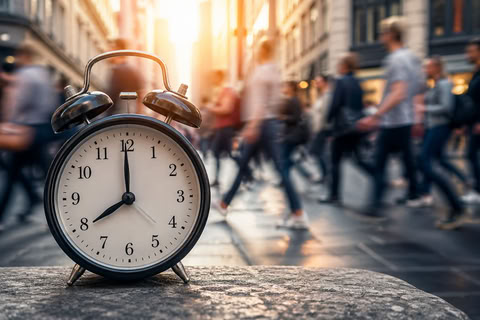 If we try to answer the question of how time feels, we should first note that there is no natural “stopwatch” inside us. We do not count seconds the way a clock on the wall does. In fact, if someone is placed in conditions without external reference points — no daylight, no schedule, no clock — their internal sense of time quickly begins to drift.
But there is another system that works reliably. Our brain constantly tracks changes around us: what happened, what changed, what makes one moment different from another. It is from these differences that our sense of time is built.
As far back as William James, it was noted that our experience of duration depends on how densely a period is filled with events. In other words, if a lot happens during a certain stretch of time, it tends to feel longer. If almost nothing changes, it feels shorter.
This is easy to imagine. Suppose you are sitting in a queue, staring at one spot, and almost nothing is happening around you. Your thoughts keep circling, the scene does not change. Five minutes pass, then half an hour, and the situation remains the same. Most likely, this time in the queue will leave almost no trace in memory, as if it all happened in a single moment. There will barely be anything to remember.
Now imagine a different day: meetings, conversations, unexpected situations, new places. In the moment, you may not even notice how quickly time is passing, but when you look back, that day seems long and full. It contains many “anchor points” for memory.
Modern research develops this idea further. Researchers speak not just about “events” but about event segments — small pieces of experience that the brain separates into distinct episodes. Whenever the context changes — the place, action, people, or task — the brain seems to place an invisible marker: one episode has ended and another has begun.
Our subjective estimate of time partly depends on how many such episodes there are. The more there are, the “longer” the period feels. The fewer there are, the more strongly time seems to compress.
We can think of each episode as a separate “frame” or “refresh” of perception. When there are many such updates, life feels dense and stretched out. When they are rare and repetitive, time seems to slip through the gaps between them.
This is the basic idea we need. Now let’s think about why childhood contains so many of these “updates”, while adult life tends to lose them.
Why Childhood Feels So Long
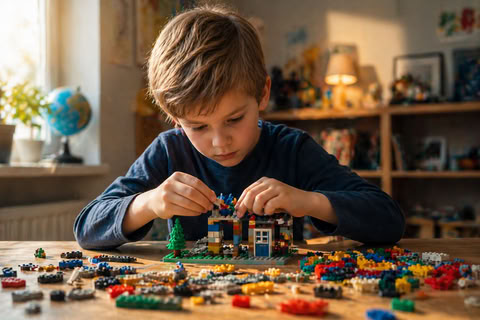 Let’s look at childhood through the lens of this article. A child enters a world in which almost everything happens for the first time. New faces, new places, new rules, new sensations. Even simple things such as the route to school or a conversation with an adult are full experiences that need to be understood, lived through, and somehow fitted into a growing picture of the world.
As a result, attention works differently than it does in adults. It does not simply glide over familiar things but catches on every detail. Any small thing can seem extremely important: an unusual sound, an unfamiliar word, a strange situation. A child cannot afford to ignore novelty because they do not yet have a large set of ready-made patterns that quickly say: “I’ve seen this before, no need to spend energy on it”.
In addition, a child’s brain is constantly in active learning mode. It does not merely register what is happening; it continuously builds new connections, tests hypotheses, remembers, and compares. This is an energy-intensive process that requires constant involvement. A young brain can afford this more easily than an aging one.
Let’s return to our metaphor of “beats”. If each act of perception and processing is imagined as a separate “trigger”, then childhood contains a great many of them. The same stretch of time is divided into more small fragments, making it feel longer and richer.
In adulthood, much of this works differently: we recognize situations faster, compress them more quickly when they seem unnecessary, and do not spend as much energy processing them. Children do not yet have this economy. They live in a world that constantly demands involvement, and so their inner sense of duration stretches out.
Why Adult Life “Speeds Up”
 As we get older, a subtle shift takes place that strongly changes our sense of time. Life does not necessarily become poorer or less eventful — it becomes more predictable. We become better at navigating familiar situations and increasingly act in them automatically.
Wake up, wash, go to work, open the laptop, answer messages — much of this happens with little effort. The reason is that the brain has learned to save resources. Why spend extra energy each time on something it has already done many times before?
Stable routines begin to form. The commute, work tasks, conversations, household details — all of this starts to repeat. At some point we stop giving these things the same full attention as before. We do not switch off; we simply stop immersing ourselves in them so deeply.
Interestingly, this does not always feel like life is speeding up in the moment. A day may be exhausting, drag on, and feel extremely long. But when we later look back at it, it can easily “collapse” in memory. That is because few distinct, unique fragments remain for memory to hold onto.
Imagine several workdays in a row that passed in roughly the same way. Looking back after some time, they often merge into one general image or pattern: “worked, handled things, nothing special”. In reality, many small actions and events happened, but they did not leave clear markers.
This creates an important and sometimes unpleasant effect. When enough such days accumulate, it begins to feel as though weeks, months, and years simply disappear — as though life is passing without meaning.
This creates a paradox: life continues and plenty happens, but if those events are repetitive and demand little active involvement, memory begins to save resources and compress them tightly, almost like a file archiver on a computer. This is what helps create the feeling that time speeds up with age.
When Time Slows Down Again — and How We Can Influence It
 Sometimes something strange happens in adult life: time begins to behave almost as it did in childhood. A single day feels full, long, rich with impressions. It seems as though you truly lived through it instead of simply “fast-forwarding”. This usually happens in three kinds of situations.
First — strong emotions. It can be anything: an important conversation, a performance, falling in love, a conflict. When we are emotionally involved, attention activates automatically. We notice more details, remember events better, and experience each moment more deeply.
Second — danger or stress. Many people note that time seems to slow down in tense situations. Some remember a car accident or another unexpected event in which everything seemed to unfold in “slow motion”. Research, including work by David Eagleman, suggests that in such moments the brain processes information more intensively. Time itself does not slow down; the density of perception increases, allowing us to register and process more information within the same interval.
Third — new situations. Travel, changing activities, learning something unfamiliar, even taking a different route or changing your surroundings. Anything that breaks us out of automatic mode forces the brain to switch on again and pay attention to what is happening. These are often the periods we later remember as especially full of life and emotion.
Of these three factors, one is not under our control at all — danger. And deliberately seeking it is hardly a good strategy, even if some people see it as an important part of a full life. Emotions and novelty, however, can be influenced. We can consciously add elements that activate attention: change familiar routines, learn something new, create situations in which we cannot simply drift along on autopilot.
An important conclusion is that time may “speed up” not simply because we are getting older, but because more and more of life is lived according to patterns we ourselves have built. If we bring more attention, novelty, and involvement into our lives, time can begin to feel slower again.
Time is not only what a clock on the wall shows, what is printed on a desk calendar, or what ticks across a television news screen. It is also deeply connected with us — and with how fully we are present in our own lives.