



Every autumn, the whole world watches the Nobel Prizes — honoring remarkable people who have changed our understanding of the world we live in. Scientists, writers, and peace advocates take the stage in Stockholm, and it can seem as though science exists only in laboratories, formulas, and microscopes. But one day, the laureate was someone who studied not the familiar fields of physics or chemistry, but the rules on the basis of which our thinking is formed and the reasons we so often make mistakes.
In 2002, the Nobel Prize in Economics was awarded to the American-Israeli psychologist Daniel Kahneman for showing that people are far less rational than classical economics had long assumed. It was a sensation — a psychologist received one of economics’ highest honors, and the world acknowledged that human behavior cannot be described by numbers alone.
Kahneman worked together with his close friend and co-author Amos Tversky, with whom he spent many years studying how people make decisions, weigh risks, and why their errors tend to occur in predictable directions. Sadly, Tversky died in 1996, and Nobel Prizes are not awarded posthumously, so only Kahneman received the prize. But Kahneman himself emphasized in every speech: “It was a joint effort. Half of my mind is Amos.”
Their research gave rise to a new field — behavioral economics, which brought together psychology, economics, and the philosophy of human decision-making. Their ideas help explain today why losses frighten us more than gains please us, why we vote for “confident” politicians, and how marketing can push us toward choices we did not really want.
The story of Kahneman and Tversky is not only about science, but also about the rare partnership of two brilliant minds who could argue intensely, doubt themselves, and laugh at established dogmas. Yet it was precisely in those arguments that groundbreaking ideas were born, revealing the principles of human thought — that very process that defines us as human beings.
Two People Who Challenged the Idea of Rationality
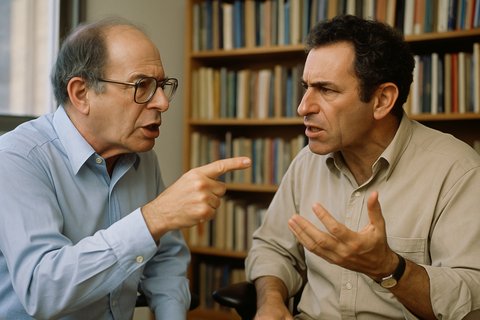 In the late 1960s, Jerusalem was not only an ancient city, but also a place where new ideas were constantly being born. At the Hebrew University, among the busy corridors of the psychology department, two people met who would go on to transform our understanding of human thought — Daniel Kahneman and Amos Tversky.
They were remarkably different. Kahneman was thoughtful, inclined to doubt and endless inner reflection. He weighed every word carefully and distrusted quick conclusions. He later said that he had been a “professional pessimist” all his life — someone who sees possible mistakes before taking action. Tversky was his complete opposite: confident, witty, brilliant, and charismatic. He grasped the essence of a question almost instantly and was not afraid to take risks. Where Kahneman saw uncertainty and a reason for caution, Tversky saw an opportunity for experiment. If the first was an introverted analyst, the second was a man of action.
According to Kahneman’s recollections, their first meeting began almost as a conflict. He was preparing a lecture for students on common errors of perception and invited his mathematically minded colleague to give his opinion. A debate broke out in the lecture hall — lively, sharp, and at times sarcastic. Each defended his own position. But at some point, both realized that they were speaking the same language — simply looking at the problem from different sides.
That was the beginning of a partnership that became legendary. They spent evenings in long conversations — sometimes at the department, sometimes in cafés on Ben Yehuda Street. Kahneman proposed perceptual paradoxes; Tversky turned them into rigorous logical structures. Together they searched for answers to questions such as: why can an intelligent person behave foolishly?
Gradually, these conversations grew into an entire research program. They began testing how people estimate probabilities, make choices, and react to uncertainty. Why, for example, do doctors overestimate the risk of complications, while investors behave irrationally in the stock market even when they have all the necessary information? They found that most people do not intuitively think in statistical terms: we judge by impressions rather than probabilities.
At the time, this idea sounded almost heretical. In the mid-twentieth century, the prevailing view was that humans were rational beings who chose whatever offered the greatest benefit. Kahneman and Tversky showed that rationality is far less absolute than that model suggested, and that in practice we are driven by emotions, associations, and mental shortcuts that the brain uses to save effort.
Over time, their collaboration became almost symbiotic. Kahneman would propose a paradox; Tversky would immediately test its logical strength. They argued, laughed, interrupted each other, and each pushed the other to think more deeply. Tversky once said: “We do not think alike — but when we think together, the result is better than what either of us can produce alone.”
By the end of the 1970s, their names were already known throughout academic psychology. Yet no one fully understood that these endless conversations between two scholars in the hot Jerusalem air were the beginning of a new era — an era in which human rationality itself would be called into question.
Why People Make Mistakes Without Noticing Them
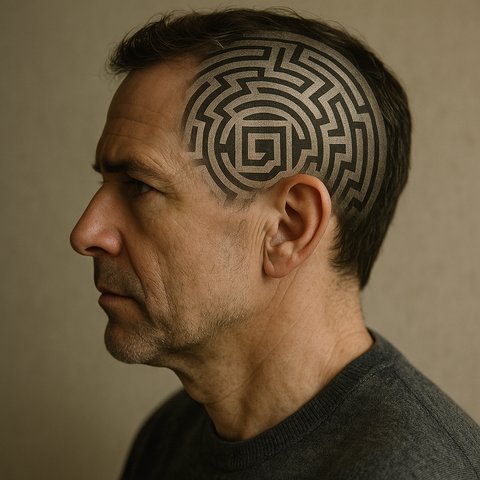 Kahneman and Tversky began with a simple but uncomfortable question: if human beings are rational, why do they make mistakes so often? Why do they make choices they later regret? Why can judges, doctors, managers, and politicians — highly educated people — make decisions that contradict common sense?
The answer lay not in a lack of knowledge, but in the way thinking itself works. Our brain does not analyze every situation from scratch — it simply does not have enough time. It operates economically: it chooses not the most precise solution, but the fastest one that seems obvious in the moment. To cope with billions of signals, the brain uses cognitive “shortcuts” (heuristics) — familiar patterns that help us quickly understand what is happening. They protect us from overload, but there is a downside — they increase the likelihood of systematic errors, which Kahneman and Tversky called cognitive biases.
One of the best known is the anchoring effect. Imagine walking into a store and seeing one coffee machine priced at 300 euros and another at 180. The second seems like a bargain, even though its real value might be 120. The reason is that the first price has “anchored” our perception. We do not judge absolute values; we compare them with an existing impression.
Another distortion is confirmation bias. We tend to look for evidence supporting what we already believe to be true and ignore anything that does not fit our picture of the world. If someone is convinced that “all politicians lie”, they will notice only the news that confirms this belief. Everything else may simply fail to reach conscious attention.
Then there is the framing effect. Kahneman and Tversky often used an example like this: people were shown two versions of the same medical scenario.
In the first, they were told: “200 out of 600 people will be saved”; in the second: “400 out of 600 will die.”
Although the meaning is identical, most people preferred the first formulation. The word “saved” created a feeling of safety, while “die” evoked fear.
This is how the brain responds not only to numbers, but to the way information is presented. From this come opportunities for manipulation in advertising, political slogans, and even the decisions we make in our personal lives.
Kahneman later described these mental traps as part of “fast thinking” (System 1 thinking). It is our inner autopilot: it works quickly and intuitively, and most of the time it serves us well. But it is also the system that can make us overestimate our understanding of the world, jump to conclusions, and overlook our own mistakes.
The most dangerous thing about cognitive biases is not that we make mistakes, but that we tend to resist recognizing them. Most of the time, we are convinced that we are acting logically, when in fact we may simply be following the brain’s familiar habits. And perhaps this was the most unsettling part of Kahneman and Tversky’s discovery: reason is not always the master in its own house.
Prospect Theory: Why We Fear Losses More Than We Enjoy Gains
 Once Kahneman and Tversky realized how irrationally people evaluate risk, they went further and tried to describe the mechanics of such decisions. This led to their famous prospect theory, the work for which Kahneman was awarded the Nobel Prize.
Classical economics makes the matter look simple: people are rational, they compare benefits and choose what brings them more. But real life does not work that way. We evaluate not only the outcome itself, but how it relates to our current reference point — to what we already have. Losing 100 euros when you have a thousand and losing the same 100 euros when you have only two hundred are emotionally very different experiences. In theory the amount is identical; in practice the pain is not.
Kahneman and Tversky proposed a simple experiment.
People were asked to choose between two options:
- A. receive 1,000 dollars for certain;
- B. a 50% chance of winning 2,000 and a 50% chance of receiving nothing.
Most people chose the first, “safe” option.
But when the wording changed:
- A. lose 1,000 dollars for certain;
- B. a 50% chance of losing 2,000 and a 50% chance of losing nothing —
those same people suddenly preferred the risky option.
The mathematics is the same, but the decisions are opposite.
This is how Kahneman and Tversky showed that we feel losses more strongly than we enjoy equivalent gains. They called this phenomenon loss aversion.
For the brain, a loss is emotionally heavier than an equivalent gain. Winning a thousand brings pleasure, but losing a thousand causes much stronger pain. That is why we often cling to the familiar even when something new promises benefits; hold on to unnecessary shares because they “might recover”; and avoid choices in which even a small thing could go wrong.
Kahneman later wrote that this fear of loss shapes our behavior more strongly than rational arguments do. We tend to avoid pain rather than seek gain. This applies not only to money, but also to love, career, and friendship. Often we do not take a risk not because we do not believe in success, but because we do not want to experience the pain of failure.
Prospect theory showed that people do not live in a world of objective numbers, but in a world of subjective experience. We make decisions not like logical machines, but like feeling beings who measure everything through their own emotions. There is nothing “wrong” with that — it is simply how evolution shaped the human brain.
When Kahneman stood on the stage in Stockholm in 2002 to receive the Nobel Prize, he spoke not about finance or markets, but about “maps of bounded rationality” — about the way people construct their world internally. He reminded us that our reason is limited, but that these very limitations are part of what makes us human.
Legacy and Influence: From Economics to Everyday Life
 When their theory spread through scientific journals, few could have imagined that Kahneman and Tversky’s psychological ideas would become the basis for new ways of understanding human behavior. But before long, they moved beyond university circles and entered economics, politics, marketing, management, and even psychotherapy.
Economists began to treat the human factor not as random noise, but as a major driving force influencing world markets. Investors began discussing behavioral traps — how fear of loss can make people panic-sell shares or hold falling assets because they are afraid to admit a mistake.
Political strategists learned to use the framing effect. Change the words, and you can change how reality is perceived. Say “tax increase” and people become angry. Say “contribution to social justice” and many will agree.
Marketers also learned how human choice works. They stopped selling only a product and began selling a feeling: safety, confidence, exclusivity. All of this rests on what two Israeli psychologists once demonstrated in a university setting: people do not always behave as logic prescribes, but often as the inner compass of emotion suggests.
But perhaps the most important legacy of Kahneman and Tversky lies not in economics, but in ourselves. Their work helped us learn to notice our own biases, to see how quickly the brain reaches conclusions and how often it can be wrong. This is not a reason for shame or proof of weakness; it is an opportunity to understand how to make decisions more consciously.
In therapy, this knowledge can help people understand why they get stuck in the same choices, why they repeat old mistakes, and why fear of loss — whether of a relationship, status, or confidence — can be much stronger than the desire for change.
In 2011, already without Tversky, who had died fifteen years earlier, Kahneman brought decades of their research together in the book “Thinking, Fast and Slow”. It became an international bestseller translated into dozens of languages. It is not merely a psychology book — it is a guide to greater awareness for modern life. Millions of readers recognized themselves in its descriptions of impulses, doubts, and habits that once seemed logical but turned out to be automatic reactions.
The legacy of Kahneman and Tversky is not in formulas, but in teaching us to question our own certainty and examine it from a more objective perspective. To understand that mistakes are not weakness, but a predictable part of thinking. And perhaps genuine rationality and strength lie precisely here — not in always being right, but in anticipating where we may go wrong, acknowledging our mistakes, and finding a reasonable solution in any situation.