



At first glance, superstitions may seem like a relic of distant times, when people explained mysterious phenomena through magic and myths. It might seem that today, in an age of technology and science, such beliefs should have disappeared. Yet they remain alive — in the small rituals, habits, and fears that accompany our everyday lives: some people avoid crossing paths with a black cat, some knock on wood so as not to “jinx” their luck, and others are still afraid of the number 13.
Why do rational people continue to see signs of fate in random events? How do superstitions arise, what psychological mechanisms lie behind them, and what role do they play in our lives? In this article, we will try to understand what lies behind this seemingly “harmless” belief in signs and omens — and just how deeply these phenomena are rooted in the nature of human thinking.
What Is Superstition from a Psychological Perspective?
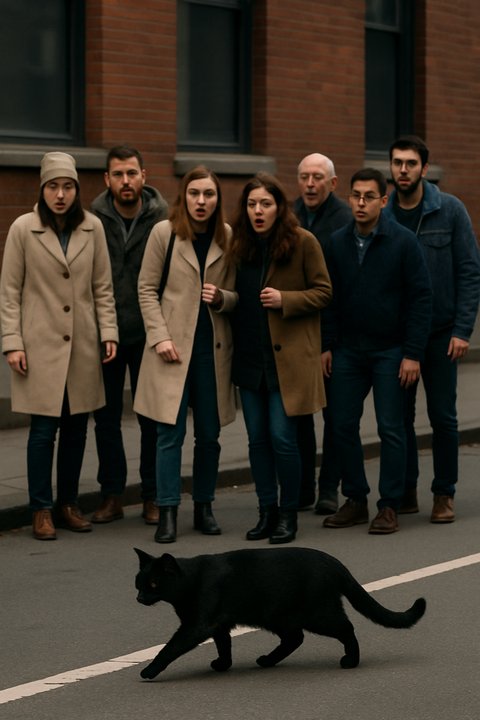 A superstition is a belief in a connection between events that have no objective cause-and-effect relationship. In other words, it is an attempt to explain random coincidences through hidden, unscientific patterns. Examples of superstition are easy to find in everyday life: “if a black cat crosses your path, expect trouble,” “if you spill salt, there will be an argument,” “if the week starts badly, the whole week will go wrong.”
From a psychological perspective, superstitions rely on several basic cognitive mechanisms.
First, there is magical thinking — the tendency to see a connection between thoughts, actions, and external events even when no such connection exists. Magical thinking is characteristic of children at early stages of development, but adults also retain elements of it, especially in situations of uncertainty or stress.
Second, there is the effect of illusory correlation — people tend to remember the occasions when an “omen came true” and ignore the occasions when it did not. Over time, this can strengthen the feeling that certain actions really do influence the outcome of events.
Superstitions are also shaped by the need for control. In unstable or threatening circumstances, belief in signs and rituals can help people cope with stress by creating a sense that they can influence the situation, at least to some degree.
It is important to note that having superstitions does not indicate low intelligence or poor education. Even highly educated people may follow “small rituals,” especially at important moments in life — during exams, in sports, or in business. Superstitions are not so much a sign of ignorance as a manifestation of deep mechanisms of the human mind, which seeks order and predictability in a world full of chance.
How and Why Superstitions Arise
 Superstitions have deep historical roots. In ancient times, people were surrounded by forces of nature that seemed unpredictable and threatening. Without scientific knowledge, natural phenomena were explained through spirits, gods, and magic. Rituals and signs served as an attempt to establish control over the surrounding world: to appease the gods, predict fate, and protect oneself from misfortune.
Over time, these practices became part of cultural traditions and were passed down from generation to generation. Many superstitions became established not because they had been verified through experience, but because they provided psychological comfort in conditions of uncertainty.
From the perspective of modern psychology, the origins of superstition can be considered on several levels:
Finding Patterns in Chaos
The human brain is inclined to search for meaning and cause-and-effect relationships even where none exist. This can be an evolutionary advantage: it is safer to make a false alarm once than to miss a real threat. This tendency makes us more likely to notice “signs” in random events.
Reducing Anxiety Through a Sense of Control
When people face uncertainty — whether illness, an exam, or a new undertaking — they instinctively look for ways to feel more in control of the situation. Superstitious rituals and signs can create an illusion of control over the future, helping to reduce anxiety.
Social Learning
Superstitions are transmitted through culture and upbringing. If a child is repeatedly told that certain actions “bring good luck” or “ward off trouble,” these associations can become deeply ingrained. In adulthood, such beliefs may continue to influence how the world is perceived, often without the person noticing it.
Positive Reinforcement
When someone happens to achieve success after performing a ritual, this can reinforce superstitious behavior. B. F. Skinner described a similar effect in his experiments with animals: if reinforcement — a reward — follows a random action, the animal may begin repeating that action as though it had caused the result.
Thus, superstition is not stupidity or a sign of weak reasoning, but the result of natural cognitive processes, historical development, and social transmission. It can help people cope with anxiety and bring a sense of order to a complex and unpredictable world — even if that comes at the price of certain illusions.
Superstitions in the Modern World: Are They Still Alive Today?
 Despite the development of science, technology, and critical thinking, superstitions have not disappeared and continue to thrive in modern society. In some areas of life, belief in omens and “special rituals” has even become more visible.
Sports
Professional athletes often follow rituals before important matches: they wear “lucky” shirts, step onto the field with a particular foot first, or follow special routines. Famous football players, tennis players, and swimmers have acknowledged following personal superstitions. Even with excellent physical training and scientific support, they may look for ways to strengthen their confidence and reduce the pressure of responsibility.
Business and Career
In business, superstition may appear in the choice of “auspicious” dates for signing deals, special attitudes toward certain numbers — for example, the number 8 in some Asian cultures — or even the habit of carrying “lucky” objects to important meetings. Under high uncertainty, people often try to strengthen their position not only through rational methods but also through the psychological reassurance provided by rituals.
Everyday Life
Superstitions also survive in everyday details: many people avoid the number 13, do not give knives as gifts without receiving a symbolic coin in return, avoid crossing a road after a black cat, or sit down for a moment before a long journey. These actions are often performed half-jokingly, yet the very urge to perform them points to a deeper need for rituals of safety.
The Role of Media and Social Networks
Modern media help spread and even create new forms of superstition. Memes about “Mercury retrograde,” trends such as “make a wish at 11:11,” or warnings about “unfavorable days” become widely popular and turn into collective rituals. Social networks spread these ideas quickly, intensifying their emotional appeal and drawing more and more people in.
The Paradox of Modern Culture
Paradoxically, greater access to education and scientific information can coexist with strong interest in esotericism, horoscopes, and magical practices. Psychologists explain this by pointing out that scientific progress does not eliminate basic human needs — for predictability, protection from uncertainty, and emotional comfort. Superstitions can function as a kind of “emotional insurance” in a complex and rapidly changing world.
Psychological Research on Superstition
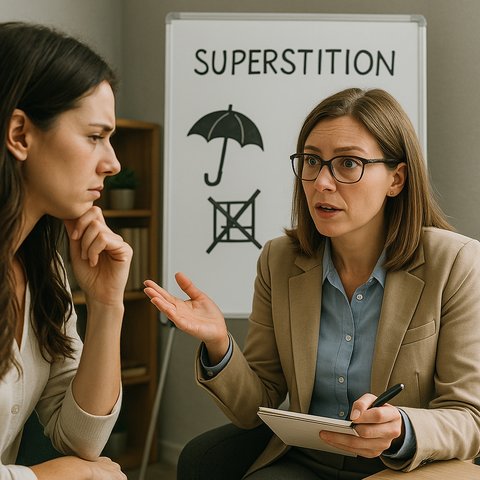 Psychological research into superstition, magical thinking, and the perception of random events has been conducted for decades. Below are some of the main approaches and terms researchers use to study these phenomena.
In the field of supernatural beliefs and magical thinking, the following established terms are commonly used:
- Magical thinking — a term describing the tendency to interpret events through supernatural or mystical laws rather than objective cause-and-effect relationships. This phenomenon is often discussed in relation to cognitive and cultural features of thinking.
- Superstitions — systems of belief in which special properties are attributed to events, objects, or actions, such as a black cat crossing the road. Superstitions can serve as a way of bringing order to unpredictable or anxiety-provoking events in a person’s life.
In the area of cognitive biases and distorted perception of randomness, important concepts include:
- Confirmation bias — the tendency to notice and remember information that confirms existing beliefs while overlooking contradictory evidence. This can contribute to the persistence of superstitious beliefs.
- Illusory correlation — a phenomenon in which people perceive a relationship between two events even when no such relationship exists objectively. For example, if something unpleasant happens after a chance encounter with a black cat, a false association may form between the cat and bad luck.
Research in behavioral psychology is also relevant:
- Animal experiments — the well-known studies by B. F. Skinner, one of the most influential American psychologists of the mid-20th century, in which researchers observed so-called “superstitious” behavior in pigeons. When food was delivered independently of the birds’ actions, the pigeons developed repetitive ritual-like behaviors that were interpreted as if they were connected with obtaining reinforcement. These observations have often been used to illustrate how superstitious behavior may arise.
- Research on stress and uncertainty — numerous experiments suggest that under conditions of stress or uncertainty, people may be more likely to rely on superstitions in an attempt to create a sense of control over the situation.
It is also useful to consider sociocultural research:
- Cross-cultural studies — these show that superstition and magical thinking appear across cultures, while their specific forms and dominant symbols can differ substantially depending on historical and cultural context. For example, in many Western traditions a black cat is associated with bad luck or dark forces, whereas in other traditions it may have positive meanings.
- Social stereotypes and symbolism — this research examines how certain images and symbols, in this case the image of the black cat, are formed and reinforced in collective consciousness and how they influence behavior.
Research tools and methods that can be used to study superstition include:
- Psychometric questionnaires — specialized scales are used to assess magical thinking and paranormal beliefs, such as the Revised Paranormal Belief Scale (RPBS) and other adapted questionnaires.
- Laboratory experiments — controlled experimental settings allow researchers to analyze how random reinforcement and the perception of correlations can influence the formation of superstitious beliefs.
- Qualitative research — interviews and observations in cultural contexts help researchers understand how superstitions develop within particular communities and what role they play in everyday life.
Psychology does not treat superstition simply as primitive thinking, but as the result of a complex interaction between cognitive and cultural factors. By studying cognitive biases, animal behavior, and sociocultural patterns, researchers try to understand why people assign special meaning to random events and how this influences perception and behavior in everyday life.
This field offers rich material for both theoretical discussion and practical applications in areas such as psychotherapy and education, where understanding cognitive mechanisms may help people work with irrational fears and superstitious beliefs.
Should We Fight Superstitions, and How Can We Approach Them Rationally?
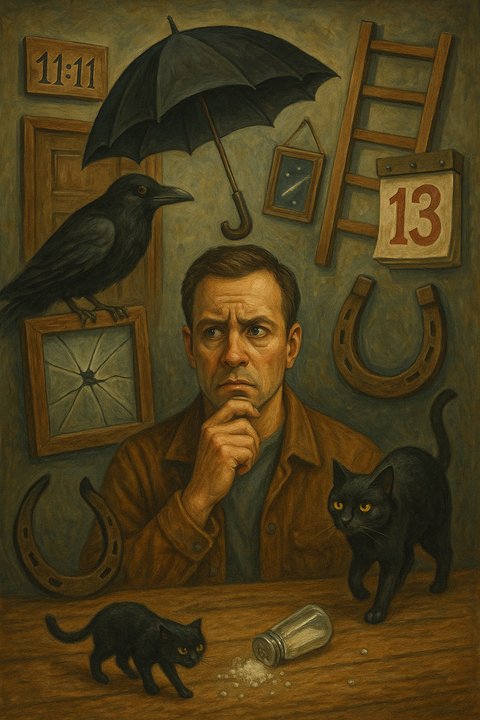 Superstitions surround us everywhere, but should we try to eliminate them completely? The answer is not as straightforward as it may seem.
In many cases, superstitious rituals can serve a positive function. They may help people cope with stress, strengthen confidence, and create a sense of order in an unpredictable world. For example, an athlete who always wears “lucky” socks before a match may feel more prepared for success simply because the ritual itself provides reassurance. Here, superstition works as psychological support — a kind of personal tradition or good-luck ritual.
If superstitions do not restrict a person’s freedom, cause excessive anxiety, or interfere with rational decisions, they can remain a harmless part of life — a kind of psychological anchor.
When do superstitions become dangerous? Problems begin when belief in omens becomes a source of fear or anxiety, or leads people to avoid important actions. For example, someone may turn down a beneficial opportunity simply because a horoscope says it is a “bad day,” or avoid certain routes out of fear of “bad signs.”
Superstitions can also be harmful when they begin to replace real safety measures or medical advice. In such cases, belief in the supernatural may lead to real harm — to health, finances, or well-being.
The key to a healthy attitude toward superstition is awareness. It is useful to remember that superstition is primarily a psychological tool, not an objective truth. Small rituals may be used for reassurance, but it is important not to let them control decisions or limit freedom. If someone notices that superstition causes persistent fear or interferes with normal life, it may be worth addressing the underlying anxiety more deeply — perhaps with the help of a psychologist.
Superstitions are neither weakness nor stupidity, but a natural part of the human mind’s search for order and meaning. Understanding how they arise and approaching them consciously can help preserve their harmless aspects while avoiding the traps of irrational fear.