



Neuro-linguistic programming, or NLP, is one of the best-known and at the same time most controversial approaches associated with psychology. The term is familiar even to people who have little interest in psychology. Some have encountered it in self-help books, others in negotiation and sales training, and still others in stories about “hidden influence” over other people.
Over several decades, NLP grew from an unusual idea developed by a small group of researchers into an entire industry of books, courses, and seminars. Attitudes toward it remain divided: some see it as a useful collection of practical tools, while others are highly skeptical.
To understand why NLP became so popular — and why it has generated so much controversy — it is worth looking at where it came from and what its creators were trying to offer...
NLP as an Idea: What Is It and Where Did It Come From?
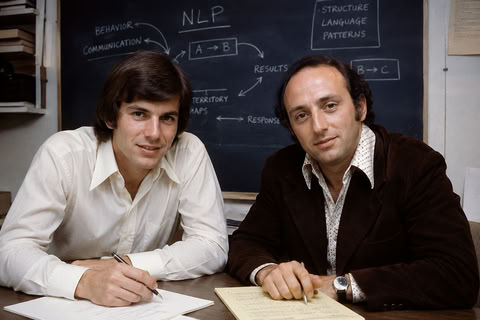 The history of NLP began in the United States in the first half of the 1970s. Its founders are generally considered to be linguist John Grinder (John Grinder) and student Richard Bandler (Richard Wayne Bandler), who was studying psychology and philosophy. They were interested in a rather unusual question: why do some psychotherapists achieve outstanding results while others, working from the same theories, are considerably less effective?
Instead of building a new school of psychology from scratch, they chose a different path. Grinder and Bandler began closely studying the work of prominent therapists of their time, trying to understand exactly what they did when communicating with clients. They were less interested in theories than in concrete actions: which words were used, how questions were phrased, how intonation changed, how the therapist responded to a client’s emotions, and how they helped the client look at a problem differently.
They paid particular attention to family therapist Virginia Satir (Virginia Satir), Gestalt therapy founder Fritz Perls (Friedrich Salomon Perls), and psychiatrist Milton Erickson (Milton Erickson), known for his unconventional approach to hypnosis. The founders of NLP assumed that if they could identify common patterns in the work of successful practitioners, almost anyone could be taught those skills.
This is where the word “programming” in the name came from. The idea was that thoughts, emotions, and habitual patterns of behavior work in some respects like programs that can be studied, changed, and replaced with more useful ones. “Neuro” was meant to point to the nervous system, while “linguistic” emphasized the role of language and communication in shaping how we perceive the world.
For its time, the idea was highly appealing. Instead of years of work on oneself, NLP seemed to promise a kind of “user manual” for human thinking: identify how successful behavior works and learn to reproduce it. This promise of rapid and understandable change largely explains the explosive growth in NLP’s popularity over the following decades.
Popular NLP Techniques
 It was probably NLP’s practical techniques that made the approach so popular. Most people are not especially interested in the history of psychological schools or debates between researchers. A much more immediate question is: can any of this actually be useful in everyday life?
One of the best-known NLP ideas is so-called “anchoring.” The basic idea is simple. Many of us have a song, a smell, or a place that can suddenly bring back feelings we thought we had long forgotten. A few notes of an old melody may evoke events from years ago — a school graduation or a first date — and with the memories comes the emotional state itself: joy, excitement, or a sense of calm.
NLP practitioners suggested that such associations could be created deliberately. For example, before an important presentation, someone might repeatedly recall a situation in which they once felt confident and calm while performing a simple action at the same time — perhaps gently pressing the thumb and index finger together. If the pairing is repeated often enough, the same gesture before a later presentation is supposed to help bring back the feeling of confidence. Even people who have never heard of NLP sometimes do something similar intuitively: one person wears a “lucky” shirt to an exam, another takes a favorite pen to a job interview, and someone else listens to the same music before every competition.
Another popular NLP idea concerns our inner dialogue. Many of us may have noticed that we are constantly talking to ourselves, often without paying much attention to it. Before a difficult conversation, someone may repeat internally: “I’m going to ruin everything,” “They’ll realize I’m not competent enough,” or “Something is definitely going to go wrong.” Interestingly, after a few minutes of this kind of inner monologue, anxiety can genuinely increase even though nothing has happened yet.
NLP practitioners suggested experimenting with the way this inner voice sounds. What happens if we imagine it not as threatening and authoritative, but as funny or ridiculous? For instance, we might hear a frightening thought in the voice of a comic cartoon character or speed it up until it turns into meaningless babble. Some people report that their anxiety decreases after doing this. Similar exercises can also be found today in some modern approaches to psychotherapy, although they are often explained through very different theoretical frameworks.
Finally, NLP became widely known for the idea of representational systems. Its supporters proposed that some people experience the world mainly through visual images, others through sounds, and others through bodily sensations and movement. This led to recommendations to listen closely to the words a person uses. If someone says, “I can see the solution to this problem,” perhaps they find images and diagrams easier to work with. If they say, “That sounds convincing” or “I need to feel that this is the right decision,” the way we communicate with them might supposedly be adjusted accordingly.
This idea was particularly attractive to teachers, managers, and sales professionals because it seemed to promise a kind of “key” to effective communication with most people. It was largely through such practical and easy-to-understand techniques that NLP quickly spread beyond psychotherapy into business, education, and personal development.
Why Is NLP So Controversial?
 Controversy around NLP began almost as soon as its popularity started to grow. The problem was not simply that the approach was unusual. The main issue was that many NLP ideas sounded clear and convincing in books and training courses but did not hold up well when subjected to scientific testing.
For example, NLP proponents claimed that each of us has a dominant representational system: one person supposedly thinks mainly in visual images, another in sounds, and a third in bodily sensations. They suggested that this system could be identified through a person’s choice of words, eye movements, and certain features of behavior, and that the information could then be used to communicate more effectively. The idea was appealing: observe someone carefully enough, and you could supposedly discover how they think and how best to influence them.
Research, however, has not reliably confirmed that eye movements reveal the nature of a person’s thoughts or that adapting speech to an assumed “dominant system” noticeably improves communication. This does not mean that a person’s words and nonverbal behavior are irrelevant. An attentive observer can certainly notice tension, confusion, or interest. But that does not imply the existence of a precise scheme that allows us to determine from the direction of someone’s gaze whether they are recalling a real event, inventing a story as they speak, or lying.
Even more questions were raised by promises of rapid, almost universal change. Training courses and popular books sometimes claimed that a particular technique could eliminate a phobia within minutes, change a long-standing habit, or significantly improve a person’s psychological state. Such anecdotes are not enough for science. To establish that a method is effective, researchers need to compare outcomes across sufficiently large groups and analyze the results statistically.
When researchers reviewed the available studies on NLP, they found relatively few high-quality investigations, often with small samples and substantial risks of error or bias. A systematic review examining NLP in relation to health found only a small number of suitable experimental studies and concluded that there was insufficient reliable evidence to support the claimed effects. Importantly, the authors were cautious: this was not proof that NLP never helps anyone, but rather evidence that its claimed benefits had not been adequately demonstrated.
This raises an obvious question: why do so many people still say that NLP techniques helped them? Personal experience of benefit and scientific evidence for a method are not the same thing. Someone may feel more confident simply because a practitioner listens carefully, helps them focus on a problem, and offers a clear exercise. Expectations can matter, as can support from a training group or simply the fact that a person has begun actively doing something rather than only worrying about the problem.
NLP was also not created from a collection of entirely new and previously unknown techniques. Its founders observed experienced psychotherapists, so NLP naturally incorporated elements resembling attentive listening, reframing, work with imagination, and emotional associations — techniques that also appear in other psychological approaches. Similar methods can be found in established forms of psychotherapy, but that does not validate NLP as a whole or confirm its theoretical explanations. The usefulness of one exercise does not prove that all of the claims surrounding the broader system are correct.
This is why academic psychology remains largely skeptical of NLP. Its distinctive claims have weak support from scientific research, while its bold promises often go far beyond the available evidence. At the same time, some psychologists, trainers, and communication specialists continue to use individual elements without necessarily calling them NLP. They take what seems practically useful: careful observation of another person, attention to wording, imagination, or emotional state.
The debate over NLP therefore rarely comes down to a simple choice between “it all works perfectly” and “it is all completely meaningless.” The more useful question is how to separate potentially helpful techniques from unsupported theories and exaggerated promises. Using a simple exercise that helps someone feel calmer before a presentation is one thing. Claiming that the same exercise reveals a universal code for controlling the human mind is something very different.
What Can We Actually Take from NLP and Use?
 If we strip away the sweeping claims about reprogramming personality, hidden influence over other people, and dramatic change within minutes, NLP leaves us with a fairly simple and interesting set of observations about human behavior.
One useful idea is simply to pay attention to our own internal state. Many of us have probably noticed that before an important conversation, exam, or presentation, the body seems to start working against us: thoughts become confused, breathing turns shallow, and attention shifts toward everything that might go wrong. In such a situation, simple rituals that restore a sense of control and calm can genuinely be helpful. Whether we call this “anchoring” or something else is not particularly important. What matters is whether a particular method helps us gather ourselves and reduce anxiety.
Working with our inner dialogue can also be useful. We rarely notice how strongly ordinary thoughts can affect our emotional state. Someone who repeatedly tells themselves, “I won’t manage this,” is unlikely to feel confident and calm. Sometimes it helps to replace such a statement with something more realistic: not “I’m going to fail,” but “I might make a mistake, but that would not be a disaster.” These changes may seem small, yet emotional resilience is often built from precisely such small shifts.
There is also value in paying closer attention to the person we are talking to. NLP sometimes promised an almost supernatural ability to read people from their words or eye movements. In reality, things are much simpler. If someone speaks slowly and cautiously, they may need more time to make a decision. If they begin to stumble over their explanation or become visibly more tense, it may be a sign that the conversation is moving into uncomfortable territory. Observations like these do not turn us into masters of hidden influence, but they can make communication more thoughtful and effective.
This is where the boundary lies between a useful tool and a dangerous illusion. Tools can help us understand ourselves and others better. Illusions promise quick solutions to complex problems and universal ways of controlling people. Psychology is usually far more complicated than any universal recipe.
Perhaps the most useful lesson we can take from NLP lies not in any particular technique, but in the idea that originally inspired its creators: by carefully observing people who do something well, we may be able to learn from them. At the same time, it is important to remember that the human mind rarely follows simple formulas, and promises of easy, instantaneous change deserve particular caution.