



“Being yourself” sounds completely natural. But in real life, for many people it can feel almost heroic. It is as though we live with two faces: an outer one, where everything is “right” and acceptable to others, and an inner one, where our real feelings and desires exist. And the more accustomed we become to playing this role, the more frightening it is to show our inner self to the people around us. This fear is often seen as a personal insecurity: “I’m just weak,” “I simply can’t do this or that,” “there’s something wrong with me, I’m not like everyone else.” But behind it there is almost always a story that began long before adulthood.
Over time, the habit of playing a certain role becomes so natural that we stop noticing the boundary between ourselves and the mask. We begin to live according to a kind of approved script that helps us get along with other people.
And then one day a person asks: “Why am I afraid to be myself?” This question is not about weakness or flaws in character. It is about how past experience shapes our protective strategies and prevents us from feeling natural. This article is an attempt to find an answer.
The First Lessons of Childhood
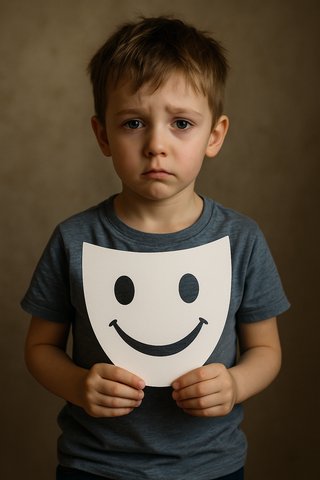 Almost every child eventually encounters a situation in which they try to behave sincerely but receive criticism and disapproval instead of support. One child laughs joyfully and too loudly, and is told: “Keep quiet, everyone is looking at you.” Another cries because they feel hurt and hears: “Stop crying, you’re too old for that.” A third wants to share a fantasy, and an adult brushes it aside: “What nonsense, don’t bother me with that.”
For a child, these are not just random phrases. They are perceived as an important message: “my openness and naturalness are dangerous.” When I am happy, I am told to tone it down. When I am angry, I am shamed. When I am sad, I am mocked. And gradually a conclusion forms: being yourself means risking the loss of love and acceptance from those around you.
At this point, the child begins trying on the first “masks.” They do not look like theatrical grimaces, but they work in much the same way. One child learns to smile all the time, even when it hurts inside. Another tries to be “easy” and guess the parents’ wishes before they are even spoken. Someone else decides to be “strong” and never cry. And the more approval these roles bring, the more firmly the inner belief takes hold: “the real me is not accepted, so I have to be a good actor.”
The difficulty is that the people around the child often have no bad intentions at all. A parent may say “don’t cry” simply because they themselves have forgotten what it means to be natural and have long been living behind their own mask. A teacher who cuts off a child’s “silly fantasies” may simply be in a hurry and fail to notice that their words have hurt someone. But in the child’s perception, such episodes become proof that openness is unsafe.
This is how the first lessons of emotional “self-censorship” are learned. Each time, the child becomes less willing to check whether it is safe to be natural. They put on the mask in advance to avoid the possible risk of ending up in an unpleasant situation. Gradually, the mask becomes a familiar part of the personality and eventually seems to merge with it completely. The person may no longer even remember what it feels like to truly laugh, get angry, or cry without fearing judgment.
The Mask as Protection
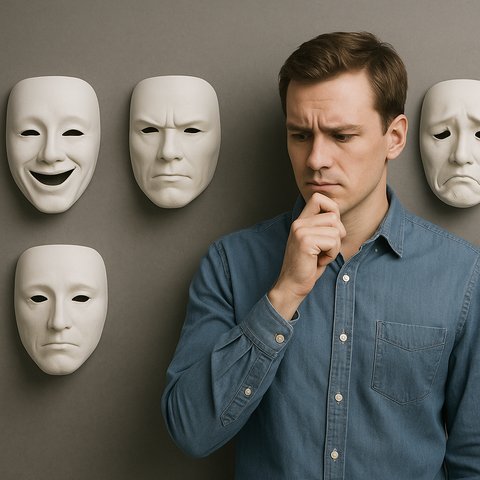 When we put on a mask, it never happens by accident. It always has one purpose: to hide what may seem dangerous or undesirable to others. In childhood, the mask protects us from criticism and punishment; in adulthood, from rejection and inner pain. The mask seems to say: “If I am easy to deal with, I will be accepted. If I stay unnoticed, no one will hurt me. If I am cheerful, I will be loved.”
This protection looks different for everyone. Some choose the mask of the “strong one.” Such a person shows neither tears, nor fatigue, nor weakness. They cope with everything alone and are not used to asking for help. At first glance, this may inspire respect, but inside there is often complete loneliness: there is no one nearby who could sometimes comfort you, say something gentle, or simply be a person beside whom you can finally relax.
Others put on the mask of the “joker.” They constantly make jokes, try to ease the tension, and lift other people’s spirits. But behind this lightness there may be sadness, anxiety, or a sense of being useful only for the moment. Laughing is easier than admitting to yourself that things are not really that cheerful.
There is also the mask of the “good girl” or the “model boy.” Such people try to live up to expectations: obey, please, avoid arguments, and adapt. They are praised for being responsible and agreeable. But inside, the feeling grows that people love not them, but only the role they perform.
And these are only a few examples. There are countless masks: the “successful professional,” the “perfect parent,” the “reliable friend.”
Their purpose is essentially the same — to be accepted by other people. And this is precisely the paradox: the mask really does work. It protects the child from shame or punishment and helps the adult fit into society and preserve useful relationships. But gradually, protection becomes a limiting factor. The mask that once gave a sense of safety begins to create heavy emotional pressure.
We keep wearing it in order to be accepted by others, but in the end, what they accept is only the mask or the image we present, not who we really are.
When the Mask Becomes a Prison
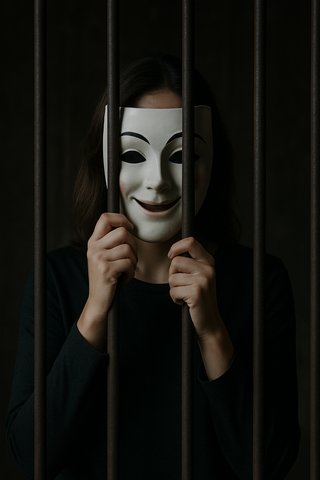 At first, the mask feels like real salvation. It helps us be accepted in a group, avoid judgment, and hide what might provoke dislike. At some point, a person may even begin to believe they have found the best possible way to live: fewer conflicts, more praise, minimal risk. But gradually this protection starts working against the person themselves.
Life behind a mask requires constant control and tension. You have to monitor your words and facial expressions and keep track of your reactions to other people. Every movement and emotion passes through an inner censor: “yes, this is allowed,” “but this is better not to show,” “if I do that, they won’t accept me.” And the longer this continues, the stronger the feeling becomes that you are not really living but performing on a stage. The morning begins with putting on the familiar role, and the entire day turns into a performance in which no mistakes are allowed.
From the outside, everything may look perfectly fine. Colleagues value the person for being reliable, friends see them as cheerful or understanding, and a partner sees someone caring and predictable. But enormous fatigue inevitably builds up over time. The person feels that their real wishes and emotions remain unspoken and unseen. Anger is covered with a smile, sadness hidden behind cheerfulness, and the need for closeness disguised as “strength and independence.”
The most painful realization is this: people value me not for who I am, but for the role I play. And that is what turns the mask into prison shackles. It is safe inside it, but cramped. It protects, but takes away the freedom to breathe deeply.
This is how protection turns into a burden: the more tightly you cling to the image, the less strength remains for living a full and normal life.
Returning to Yourself
 Being afraid to be yourself is not a sign of weakness. It is a natural reaction if sincerity once came at too high a price. The brain remembers everything connected with the idea that “openness = risk,” and so even in adulthood we continue hiding behind the roles we have chosen. But it is important to begin understanding that fear does not mean “there is something wrong with me”; it means that at some point I put on an extra layer of protection.
The path back to your authentic self begins with very small steps. The first is to honestly recognize your true feelings, even if only to yourself. Do not hide anger behind “I’m just tired,” do not trap sadness behind a smile, and do not dismiss joy as something childish or foolish. The feelings we hide are a natural part of us. They do not make a person bad; they simply show that the person is alive.
Then you can try carefully sharing this with someone close. This does not mean you have to pour out your whole soul to everyone you meet. It is enough to choose one person you trust and who is capable of understanding. Say: “I feel anxious right now,” “I’m tired,” “I’m happy about this.” You may discover that the world does not collapse, that trust can appear, and that the relationship can become warmer. These small experiences of sincerity gradually build confidence: it is possible to be yourself, and it can feel deeply good.
Another step is to look for people and situations in which authenticity is genuinely valued. These may be old or new friends, an interest group, a therapy group, or simply communication with someone around whom there is no need to put the mask back on. Then the first feeling grows stronger: I can breathe easily, I can be real, and I am accepted as I am.
When the mask stops being compulsory, a sense of lightness returns to life. It becomes possible to feel, laugh, and get angry without artificial filters. Closeness appears when relationships are built not on invented or cinematic images, but on natural communication. And most importantly, there is a feeling of boundless freedom! The very freedom we so often lack: the freedom to be yourself without fear of the consequences.
So, the fear of being yourself is not a personal weakness. It is a form of protection we once developed in order to survive and be accepted. But it does not have to stay with us for life. When there is enough safety, trust, and support around us, this protection can gradually and gently be removed.
Returning to yourself means stopping playing someone else’s role and allowing yourself to live without constant tension. It is not always easy and may require some courage, but this is where the taste of real life appears — with all its emotions, closeness, and the possibility of being who we truly are.