



For many people, the word “exam” brings up anything but pleasant associations. Even years after finishing school or university, simply hearing the word can make something tighten inside. Some remember staying awake all night before an important test. Others remember standing outside the exam room with trembling hands. And some remember forgetting everything they knew at the very moment they had to answer.
Why does this happen? After all, an exam is essentially just a way of assessing knowledge. Yet in real life it often turns into a genuine psychological duel — with ourselves, with expectations, with the past. Sometimes we are not afraid of the task itself, but of what stands behind it: the fear of making a mistake, the feeling of shame, the expectation of failure.
In this article, we will look at what exactly makes exams so stressful, where these emotions come from, and how we can cope with them. Without complicated terminology, in plain language — so that we can understand ourselves and perhaps feel a little less anxious next time.
What Happens to Us Before an Exam?
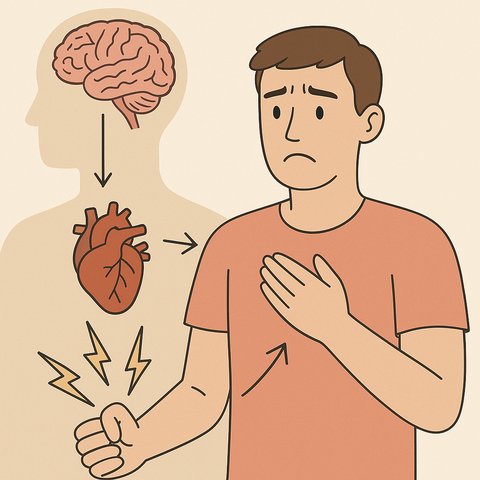
An exam is supposedly just a test of knowledge. But in the mind and body it is often experienced as something much more serious — as a real threat. That is why many people become genuinely shaky before an exam.
You may have learned everything, understood the subject, and even reviewed it. But then exam day approaches — and it starts: your heart pounds as if you were running a marathon, your palms become sweaty, your stomach knots up, your thoughts get tangled and, as if on cue, the feeling appears: “Everything has gone out of my head!”
This is not random and not weakness. It is a typical biological response to stress. Our brain is built to activate a protective system at the slightest sign of danger. And although an exam is not a fight or a fire, the brain can perceive it as a social threat. In particular, we are afraid of looking stupid, afraid of disappointing our parents, teachers, or ourselves, afraid that “mistake = failure,” afraid that one grade will change our life.
These fears trigger a stress response based on the release of adrenaline and cortisol. The “fight or flight” response switches on.
What happens in the body at this moment? The following:
- The pulse speeds up — so blood reaches the muscles faster.
- Blood vessels in the digestive tract constrict — which is why appetite disappears and the stomach may churn.
- Muscles tense — the body is preparing for action, not for calmly sitting at a desk.
- “Unimportant” brain functions slow down, including long-term memory. That is why this can happen: “I knew it, I read it, but I can’t remember!”
Almost everyone has experienced this: at home you answer questions calmly, but in the exam — your mind goes blank. This is not laziness or ignorance, but the brain working under pressure. In effect, it closes off part of its “archives” to focus on survival. It is like arriving at a job interview and, at the most important moment, being unable to remember your own address.
And sometimes the opposite happens. Some people react differently: apathy, fatigue, the feeling that “I’m going to fail anyway.” This is more like a shutdown, when the body “gives up” and saves resources instead of fighting. Such a state is often mistaken for laziness or procrastination.
Where Does the Fear Come From: Memories, Pressure, and Expectations
 Fear of exams rarely appears out of nowhere. Most often, it is not really about the exam ticket, the periodic table, or even the teacher. It goes deeper. It comes from the past — from school, family, failed attempts, and the way people treated us back then.
Many adults continue to fear exams as though they were ten years old again. They remember situations when someone shouted at them for a bad grade, they were compared with top students, they raised their hand, made a mistake — and everyone laughed, their parents said: “Look, you’re embarrassing the family!”
We may consciously forget these episodes, but the body and emotions remember. So even if you are an educated adult with a job and plenty of experience, that same schoolchild can wake up inside you — the one who was judged, rejected, and forced to live up to expectations.
So it turns out that we are not afraid of the exam itself, but of what it seems to say about us. The exam becomes a symbol: you are no longer simply answering questions — it feels as though you are standing trial. If you pass, you are “good.” If you make a mistake, you are stupid, you did not try hard enough, you are somehow “wrong.” This replaces the very meaning of the exam. It stops being a test of knowledge and becomes a test of personal worth. We are not afraid of failure itself, but of the conclusion: “Something is wrong with me.”
One of the heaviest sources of fear is expectations: parents’ expectations, society’s, and our own. Nobody can see them, but they are like a backpack full of bricks that we carry around. “You have to be the best.” “Only an A — anything less is a disgrace.” “You have no right to make a mistake.” “If you fail, you’re a loser.” Under that kind of pressure, even a simple task can turn into a nightmare. Because now it is not just a test, but an ordeal that seems to determine whether you deserve respect and love — from others and from yourself.
What We Do Wrong Before an Exam
 As the exam gets closer, it seems logical simply to sit down and study. But in reality, we often begin behaving... in exactly the opposite way. Not because we are lazy or stupid — that is simply how the mind can react under pressure.
One of the most common mistakes is putting off preparation. We know we should start, but suddenly find a hundred other “important” things to do: wash a mug, watch “one video” to get in the mood, start a beautiful notebook with a plan, choose the perfect blanket for studying... In reality, this is a defense mechanism. The brain is afraid not of the exam itself, but of the anxiety and uncertainty it creates. And instead of “going into battle,” it steers us toward somewhere calmer.
Many people also think that the night before an exam is the time for a heroic feat: “I’ll review everything now and definitely learn it!” In the end, your eyes keep closing, but you force yourself to read, nothing stays in your memory, and in the morning you feel exhausted and foggy-headed. The irony is that sleep is much more important than one more page. During sleep, the brain organizes information and transfers it into long-term memory. And insomnia makes us more vulnerable, irritable, and forgetful.
Sometimes we fool ourselves: it looks as though we are studying, but the effect is zero. It may look like this: mechanically reading a text without trying to understand it, highlighting entire paragraphs (the brighter, the smarter?), repeating the same thing over and over because everything else feels frightening. This creates an illusion: “I’m studying,” although in reality we are just going around in circles.
Sometimes we even unconsciously do not want to prepare properly. It sounds paradoxical, but it works like this:
- if I did not prepare, then “failure isn’t really my fault,”
- if I fail, I can say: “Well, I didn’t really try,”
- that is easier than giving it your all and facing the possibility of defeat.
This behavior is an attempt to protect our self-esteem. We do everything we can not to end up feeling “stupid” — even if that means going into the exam unprepared.
How to Help Yourself: Simple Psychological Techniques
The good news is that exam stress can be managed. You do not have to become a Zen master and meditate for three hours a day — a few simple steps that genuinely help can be enough.
Sleep, breathing, and food are part of preparation too! Our brain is not just a storage system for information, but a living organ. And it needs:
- Sleep, so knowledge can be absorbed. Without sleep, new information remains “in draft form” and does not move into memory.
- Food, so the brain does not have to run on crumbs. Better something light — not sweets, but something with protein and something warm.
- Breathing. Yes, simply breathing deeply. When we are anxious, we breathe shallowly and the brain does not get enough oxygen. Five deep breaths in and out can help bring back clarity and a sense of control.
These things may seem unimportant — but they create the foundation on which all preparation rests.
 Preparing a little at a time is better than being heroic at the last moment. Systematic preparation does not mean “sitting at your desk all day.” It means small but regular steps: 20–30 minutes a day, with short breaks, reviewing again after a day or two so the information has time to “settle in.” The brain absorbs repeated and varied information better than material crammed in one night. When you do a little every day, you send yourself a message: “I can handle this.” That reduces anxiety and makes the process feel manageable.
How can we deal with our fears? We often allow thoughts such as these to run through our heads: “I’m definitely going to forget everything,” “I won’t cope,” “If I fail, it’s the end.” But thoughts are not facts. You can answer them. Try telling yourself: “I’m preparing. I’m doing what I can,” “Failure is not a catastrophe, but an experience,” “It’s only an exam, not a sentence,” “I’m not the only one — everyone gets nervous.” This kind of inner dialogue is not naive self-comfort. It is a tool for stabilizing yourself. Imagine that you are your own coach — one who does not shout, but encourages.
And most importantly — do not forget about yourself! Pet a cat. Take an extra walk around the block. Call a friend. Pause and remind yourself: you are not only a pupil, student, or exam candidate. You are a person. And you have the right to support yourself, even in a stressful situation.
An Exam Is Not an Enemy, but Practice
 An exam is often perceived as an enemy: a malicious supervisor just waiting for you to fail. But in reality, it is simply one of life’s training exercises. Sometimes difficult, sometimes unfair, but still — just practice!
An exam is not a sentence, not a label, not your only chance. It is a moment when you test yourself. Sometimes you manage — sometimes you do not. But whatever happens is experience. Even if you fail, forget something, or panic — that is not defeat. It is like your first attempt to jump into the water or speak a foreign language. At first you are unsure. Then, little by little, it gets better.
We often fear failure more than the exam itself. But failure is not a brand stamped on you. It is information. A signal: where you did not understand something, where you burned out, where you could not cope — and what to do with that next. Look at some well-known people:
- Albert Einstein did not pass some of the entrance examinations for the polytechnic.
- Winston Churchill failed many exams in his youth.
- Oprah Winfrey was once rejected when she was young for having an “unsuitable on-air image.”
- Bill Gates and Steve Jobs dropped out of college.
Their failures did not become the end. They became a starting point!
There is another paradox: the more often we encounter this kind of stress, the less frightening it can become. Yes, at first it is scary — like the first parachute jump or the first public performance. But over time you get used to that nervous energy. It can become a motivator rather than a brake. Some people even begin to seek out such situations — not for the pain, but for the thrill. Because overcoming yourself can feel good. It gives a sense of victory, growth, and forward movement.
Exams are not going to disappear. But we can change our attitude toward them. And if you manage to do that, an exam stops being something terrifying and becomes a point of growth. And, in the end, that is exactly what it is for.