



Ivan Petrovich Pavlov, an outstanding Russian physiologist, is best known for his research on conditioned reflexes, which had a significant influence on the development of behaviorism — a school of psychology focused on observable behavior and the role of external stimuli in shaping responses.
Pavlov's Experiments with Conditioned Reflexes
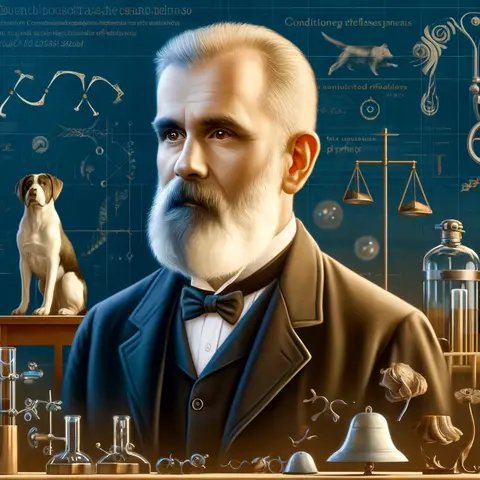 Pavlov initially studied the digestive system in dogs and received the Nobel Prize in Physiology or Medicine in 1904 for his work in this field. However, his most famous experiments concerned reflex responses and, in particular, the phenomenon of the conditioned reflex. Here is how they were conducted and what conclusions he reached:
A. Unconditioned and conditioned reflexes
Unconditioned reflexes are innate, automatic responses of the body to certain stimuli. For example, a dog's salivation at the sight of food is a natural, automatic response of the body to food.
Conditioned reflexes are acquired responses that develop through associations between neutral stimuli and unconditioned responses.
B. The experiment with the dog and the bell (classic experiment)
Pavlov noticed that a dog began to salivate not only at the sight or smell of food, but also when the person who usually brought the food appeared. This observation led him to the idea of conditioned reflexes. Pavlov decided to study this phenomenon under controlled conditions. He carried out the following experiments:
- Unconditioned stimulus: Food was presented to the dog, producing a natural response — salivation (an unconditioned reflex).
- Neutral stimulus: At the same time, a bell sounded (a neutral stimulus), which by itself produced no response.
- Formation of the conditioned reflex: After repeatedly pairing the bell with the presentation of food, Pavlov found that the sound of the bell alone (without food) soon began to produce salivation. He called this process a conditioned reflex.
C. Conclusions
Conditioned reflex is the result of an association between a neutral stimulus (the bell) and an unconditioned stimulus (food). This reflex develops through learning rather than innate mechanisms.
Pavlov identified two main phases:
- Formation of the conditioned reflex: Establishing an association between the neutral and unconditioned stimuli.
- Extinction: If the conditioned stimulus (for example, the bell) is repeatedly presented without reinforcement (food), the response gradually weakens and eventually disappears.
Pavlov also made several important discoveries that expanded the understanding of reflexive behavior:
A. Generalization and discrimination
Generalization: A dog may respond not only to the original bell sound but also to similar stimuli. This means that if a similar sound is used instead of the bell, a similar response may occur.
Discrimination: After training, a dog can be taught to distinguish between similar stimuli. For example, if food is given only at a particular sound frequency, the dog will stop responding to other sounds.
B. Extinction and spontaneous recovery
Extinction: If the conditioned stimulus (the bell) is presented without reinforcement (food), the conditioned response gradually weakens and disappears. However, this process is reversible.
Spontaneous recovery: After some time, the conditioned reflex may return if the pairing of the conditioned and unconditioned stimuli is repeated.
Pavlov's Nobel Prize
Ivan Pavlov received the Nobel Prize in Physiology or Medicine in 1904 for his outstanding work on the physiology of digestion. The award was connected with his research into the mechanisms governing the activity of the digestive glands, which he described in detail in his works.
The main work that led to the prize
Pavlov studied the secretion of gastric juice and saliva in animals. He demonstrated that secretion is regulated not only directly by the presence of food in the stomach, but also by nervous signals associated with the expectation of food (which later formed the basis for the study of conditioned reflexes).
Pavlov showed that different parts of the stomach and digestive system perform specialized functions. His research helped explain how different glands respond to different types of food, such as carbohydrates, proteins, and fats.
Pavlov developed and used innovative surgical methods to observe the activity of glands in animals. This made it possible to directly measure the quantity and composition of secretions, something that had previously been impossible. His discoveries had significant clinical applications, including the treatment of digestive disorders and the development of medicines affecting gastric secretion.
Award ceremony
The formal Nobel Prize ceremony traditionally takes place in Stockholm, Sweden. In 1904, the ceremony was held at the Stockholm Concert Hall. Pavlov personally traveled to the ceremony despite the difficulties of traveling from Russia to Europe in the early twentieth century. It was a major event in his life and career.
The prize was presented by King Oscar II of Sweden. The king personally congratulated the laureate.
At the ceremony, Pavlov delivered a speech in which he explained the significance of his research for science and medicine. His words were highly praised by the scientific community.
The presentation of the prize was accompanied by a traditional banquet attended by scientists, members of the Nobel Committee, representatives of the royal family, and other guests. Pavlov was one of the central figures at the event.
Interesting facts
- It was one of the first Nobel Prizes in Physiology or Medicine (the prize was being awarded for only the third time).
- Pavlov kept the prize money (about 150,000 Swedish kronor) to support his scientific research and laboratory.
- His Nobel Prize was not only recognition of his contribution to physiology, but also a symbol of international recognition of Russian science.
Pavlov's Influence on Behaviorism
Pavlov's experiments had an enormous influence on the development of behaviorism, especially in the work of psychologists such as John Watson and B. F. Skinner. Here is how this happened:
Behaviorism in psychology seeks to study only observable behavior and rejects the study of inner consciousness or mental processes, considering them inaccessible to objective analysis. Pavlov showed that behavior can be shaped and changed through associations and learning, which became a foundation for behaviorists who argued that all behavior results from learning through interaction with the environment.
Pavlov's experiments became a classic model for understanding how behavior can be shaped through conditioned reflexes. This model became known as classical conditioning and formed the basis for many other experiments studying the mechanisms of learning.
Influence on American behaviorism
- John Watson: One of the founders of American behaviorism, Watson used Pavlov's ideas in his experiments and argued that any kind of personality could be shaped by changing the external environment and reinforcing particular responses.
- B. F. Skinner: He developed Pavlov's ideas further by introducing the concept of operant conditioning, in which behavior is regulated not only by stimuli but also by consequences (rewards or punishments).
Influence on Psychotherapy and Education
Treatment of phobias: Principles of classical conditioning are applied in psychotherapeutic methods such as systematic desensitization, in which the patient gradually becomes accustomed to phobic stimuli, thereby weakening fear.
Education and upbringing: In education, principles of reinforcement and conditioned reflexes are used to shape skills and behavior in children.
Ivan Pavlov's work was revolutionary for its time and had an enormous influence on psychology, especially behaviorism. His research showed that many aspects of behavior can be explained through associative learning and laid the foundation for further study of reflexes and conditioned responses as key mechanisms of behavior.