



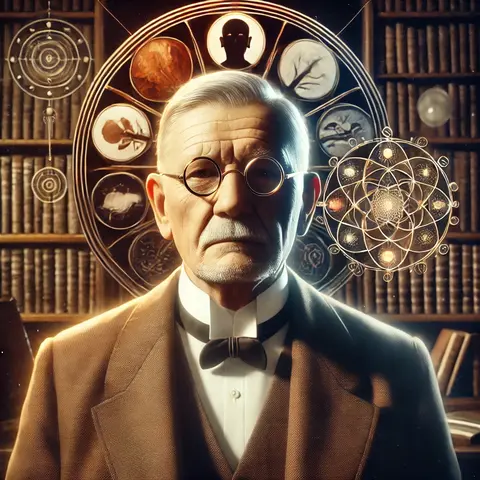
 Carl Gustav Jung (1875–1961), a student of Freud, founded analytical psychology, expanding the theory of the unconscious. He introduced the ideas of the collective unconscious and archetypes such as the "shadow," "anima," and "animus." Jung also developed the theory of individuation, a process of self-knowledge and integration of different parts of the personality. These ideas became the foundation of analytical psychology and had a major influence on various schools of psychotherapy, philosophy, and culture.
Collective Unconscious
The collective unconscious is one of the key concepts in Carl Gustav Jung’s analytical psychology. According to him, the collective unconscious is a level of the psyche shared by all people, regardless of cultural background, personal experience, or other individual differences. It is a kind of universal human "psychic repository" containing archetypes, images, and symbols that manifest unconsciously in our lives, dreams, myths, and even religious beliefs.
Jung believed that the human psyche consists of three levels:
- Consciousness — the level at which we are aware of our own thoughts, actions, and feelings. This is the level at which we operate in everyday life.
- Personal unconscious — the part of the psyche where repressed or forgotten memories, thoughts, and emotional experiences related to individual experience are stored.
- Collective unconscious — a deep layer that does not depend on personal experience. It is present in each of us from birth and contains archetypes — innate, universal images and symbols passed down from generation to generation.
Archetypes
Archetypes are basic structures of the collective unconscious, a kind of "psychic template" expressed in certain images and narratives that are similar among different peoples and cultures. Among Jung’s best-known archetypes are:
- Persona — the mask a person wears in society in order to adapt and meet the expectations of others.
- Shadow — the dark and repressed part of the personality containing instincts and desires that do not conform to social norms.
- Anima and animus — the feminine principle in a man (anima) and the masculine principle in a woman (animus), representing inner opposites and symbolizing a striving for wholeness.
- Self — the central archetype that strives for harmony between consciousness and the unconscious and for the ultimate integration of all aspects of the personality.
Why is understanding the collective unconscious important?
Jung believed that understanding the collective unconscious and its archetypes helps a person in the search for authentic individuality, wholeness, and self-development. This knowledge can be useful in therapy when a client becomes aware of inner conflicts and aspirations and understands which unconscious motives lie behind their behavior.
The collective unconscious reveals ways in which people can understand one another at a deeper level, because it suggests that we share the same basic archetypes and images despite differences in our personal histories and cultures.
Theory of Individuation
The theory of individuation occupies a central place in Carl Jung’s analytical psychology. Jung regarded individuation as a process through which a person becomes "themselves," becoming aware of and integrating different aspects of the personality and achieving wholeness and inner harmony. The goal of individuation is to find a balance between consciousness and the unconscious, reconcile the personal and collective unconscious, and realize one’s unique potential.
Main stages of individuation
Individuation includes several stages, at each of which a person interacts with archetypal images such as the Shadow, Anima (or Animus), Persona, and Self:
1. Confrontation with the Persona
The Persona is the social "mask" a person wears in order to meet society’s expectations. It is formed under the influence of the environment, culture, and upbringing. At the first stage of individuation, a person must realize that the Persona is only part of the "self," not the whole personality. Recognizing this helps reduce dependence on external roles and expectations and allows a person to move toward deeper self-knowledge.
2. Awareness and integration of the Shadow
The Shadow symbolizes those aspects of the personality that a person considers undesirable, repressed, or socially unacceptable. At the stage of encountering the Shadow, a person must become aware of and accept it rather than repressing true aspirations, fears, and complexes. Recognizing the Shadow allows a person to become more whole and freer from the inner conflict caused by self-rejection.
3. Contact with the Anima or Animus
The Anima and Animus represent opposite inner principles: the Anima is the feminine principle in a man, while the Animus is the masculine principle in a woman. This stage is connected with integrating the opposite principle, which enriches the inner world and promotes harmony. Jung believed that contact with these archetypes helps a person become aware of and accept their emotional side (for men) or rational side (for women).
4. Striving toward the Self
The Self is the center of the entire psyche and the ultimate goal of individuation, symbolizing genuine wholeness of the personality. It encompasses both conscious and unconscious aspects of the psyche, providing balance and unity among all aspects of the personality. Individuation is completed when a person reaches the Self, which allows them to find the true meaning of life and understand their place in the world.
Why is individuation necessary?
Jung believed that individuation is a path to genuine freedom and maturity, on which a person frees themselves from conventions and automatic patterns imposed by society and learns to live in harmony with themselves. This does not mean ignoring society or its values, but rather making a conscious choice to live one’s own life rather than someone else’s.
Jung emphasized that individuation requires courage and a willingness to face difficulties: becoming aware of and integrating the Shadow, for example, can be a painful process. Yet it is precisely through this that a person finds their own path and values, while reaching the Self symbolizes attaining fullness and inner peace.
Individuation in therapy
Jung used individuation as a basis for psychotherapeutic work, helping patients become aware of and integrate all aspects of their personality. Through the analysis of dreams, myths, and symbols, the therapist guided the patient along the path of individuation, supporting the discovery of new aspects of the self and the achievement of harmony between consciousness and the unconscious.
The process of individuation, according to Jung, is not a one-time event but a long journey, a path a person follows throughout life. With each stage, the person becomes more aware and whole, achieving deeper self-knowledge and inner freedom.
Individuation in life and culture
Jung believed that this process is often initiated by crises or life events such as transitions, trauma, or even creative insights. Individuation can also be supported through work with dreams, art, and psychotherapy, where a person encounters unconscious aspects of the psyche.
Thus, individuation is a long process of personal and spiritual growth leading to deeper self-awareness and greater wholeness of personality.
Jung proposed that it is important for a person not only to become aware of and rationally understand the psyche, but also to learn to interact with the unconscious. In this process, it is important not to reject any part of the psyche, but to learn to live in harmony with it.
Carl Gustav Jung’s Influence on Psychology
Carl Gustav Jung had an enormous influence on psychology, especially in the field of depth psychology and the study of the unconscious. His ideas and concepts expanded understanding of the psyche and human nature, bringing significant changes to approaches to psychotherapy and to the study of mythology, culture, and spirituality. Jung’s contribution remains relevant, and his works are used in a wide range of fields — from psychology and psychotherapy to literature, art, and religious studies. Here are the main areas in which Jung left a significant mark.
1. Development of analytical psychology
Jung became the founder of analytical psychology — an approach that supplements classical psychoanalysis and develops it toward a deeper study of the unconscious, myths, and archetypes. Jung proposed that the human psyche consists not only of personal experience (as Freud believed), but also of a collective unconscious inherited from our ancestors and consisting of universal archetypes.
2. The concept of the collective unconscious and archetypes
The theory of the collective unconscious and archetypes is one of Jung’s most significant and distinctive innovations. He showed that many aspects of our psyche contain universal images expressed in myths, religions, legends, and the art of all cultures. This discovery gave psychologists new ways to interpret dreams, symbols, and even collective phenomena such as mass behavior and cultural traditions.
3. Development of the theory of individuation
Jung introduced the concept of individuation — a process through which a person discovers inner possibilities and becomes a whole personality by integrating unconscious aspects of the psyche. This became a foundation of Jungian therapy and inspired many therapists to help patients find balance among different aspects of their personality. The concept of individuation enriched not only psychotherapeutic practice, but also philosophy, education, and person-centered approaches.
4. Contribution to personality psychology
Jung developed one of the earliest personality typologies, identifying such basic traits as introversion and extraversion. He also proposed four basic psychological functions — thinking, feeling, intuition, and sensation — which became a foundation for modern approaches to personality typology, such as the MBTI (Myers-Briggs Type Indicator).
5. Use of symbolism and mythology in psychotherapy
Jung was the first to bring myths and religious and cultural symbols into the analysis of the human psyche, viewing them as expressions of universal archetypes. His method of analyzing symbols opened new approaches to the study of dreams, creativity, and spiritual experiences. Jungian methods of dream and symbol analysis still form a basis for a number of schools of psychotherapy, especially in work with severe psychological states and trauma.
6. Influence on psychotherapy
Jung expanded traditional psychotherapeutic approaches by proposing the technique of active imagination, work with archetypes and dreams, and approaches that make it possible to integrate religious and cultural experiences into therapy. His methods are still actively used, especially in Jungian psychotherapy, as well as in art therapy and other integrative approaches.
7. Influence on the study of spirituality and religion
Jung drew the attention of psychologists and philosophers to the study of spirituality, religious experiences, and symbols, linking them with psychic processes. His view of religion as a reflection of inner psychic processes and archetypes influenced the development of transpersonal psychology, which studies spiritual and mystical aspects of human experience.
8. Contribution to art, literature, and cultural studies
Jung influenced literature, painting, cinema, and other forms of art. His ideas about archetypes inspired artists and writers to explore myths and the collective unconscious, leading to the creation of deeper and more multilayered works. For example, many writers, such as Hermann Hesse, used Jungian ideas in their work.
9. Development of Jungian dream analysis
Jung proposed a distinctive approach to dream analysis in which dreams are regarded as messages from the unconscious containing important symbols and archetypes. Unlike Freud, who believed that dreams reflect repressed desires, Jung thought that they can offer answers and solutions needed for personal growth.
10. Influence on humanistic and transpersonal psychology
The Jungian concept of the psyche and the understanding of its spiritual, mythological, and transcendent aspects helped prepare the ground for the development of humanistic and transpersonal psychology, including the work of Abraham Maslow and Stanislav Grof. These approaches also emphasize self-realization and the search for meaning, which echoes Jung’s theory of individuation.
Carl Gustav Jung became one of the founders of depth psychology. His work and ideas opened up a new understanding of the psyche, self-knowledge, and spiritual search. Jung’s influence can be seen in psychotherapy as well as in cultural studies, religious studies, literature, and art. His theories and approaches are used to better understand human motives and aspirations and to explore deeper aspects of personality.