



I. G. Bazhanov, E. A. Razorenova
State Educational Institution of Secondary Vocational Education “College of Automation and Information Technologies No. 20”,
Moscow
FinecoSoft LLC, Moscow
Modern vocational education is going through a period of major change. Vocational education in Moscow, in connection with changes caused by the entry into force of the new Law on Education and new Federal State Educational Standards in vocational education, is actively involved in processes taking place at the regional level.
The most important of these are:
- development of the Moscow Education Quality Standard;
- restructuring of the secondary vocational education system through the consolidation of colleges;
- development of network cooperation between institutions within Moscow’s secondary vocational education system;
- expansion of social partnership, understood as interaction with participants in economic life and the labor sphere in order to improve the effectiveness of vocational education.
In recent years, a number of issues concerning secondary vocational education in the capital have become particularly pressing. They have been raised both by government institutions and by the public — the direct consumers of educational services. The most urgent of these, requiring continuous work to improve both the educational process itself and the technologies used to manage educational institutions, are:
- improving the quality of student training in secondary vocational education institutions in order to ensure their competitiveness in the labor market;
- increasing the efficiency of secondary vocational education institutions in order to use public funding allocated to the organization of the educational process and staff training in a more systematic manner;
- developing and improving the material and technical resources of colleges, as well as educational, information and communication, and management technologies, in order to ensure stable development and increase the competitiveness of educational institutions in the educational services market, including as centers providing commercial staff training for enterprises and organizations in the region.
It is no secret that salaries in the non-state sector of the economy are still generally higher than salaries for comparable positions in the public sector. As a result, most college graduates seek employment in private business, where the strictest requirements are placed on the level of development of certain competencies in prospective employees.
Characteristics of the Socio-Economic Situation at the Present Stage of Development
Let us consider the characteristics of the social situation in Russia as a whole, and in Moscow in particular, within which a modern college operates, including its assistance to graduates in finding employment. To gain an understanding of this context, we will turn to several studies conducted by leading international and Russian research and analytical centers.
- Human Development Index
For example, to understand the general situation, the results of a study by the Russian office of the United Nations Development Programme are of interest. The study contains data on living standards and social development in different countries, as well as a systematic assessment of trends in key components of human development expressed in the composite Human Development Index (HDI).
The Human Development Index is a composite indicator of the level of human development in a particular country, which is why it is sometimes used as a synonym for such concepts as “quality of life” or “standard of living.” The HDI measures a country’s achievements in terms of health, access to education, and the actual income of its citizens.
The HDI ranges from 0 to 1, with 0.800 regarded as the lower threshold for developed countries. The results, reflecting the situation in 80 Russian regions, indicate that the HDI in 17 regions of the Russian Federation is below this threshold of “social success” in developed countries.
- Ranking of National Higher Education Systems
In 2012, the international university network Universitas 21 conducted the first study devoted to ranking the national higher education systems of countries at different stages of economic development.
The ranking was calculated using a methodology developed by the Institute of Applied Economic and Social Research at the University of Melbourne, Australia, and evaluates national higher education systems according to the following main indicators:
- resources (investment from the private and public sectors) — 25%;
- outputs (research, scientific publications, the extent to which higher education meets the needs of the national labor market, including subsequent employment of graduates) — 40%;
- connectivity (the level of international cooperation, demonstrating the degree of openness or isolation of higher education systems) — 10%;
- environment (government policy and regulation, access to education) — 25%.
The final calculations were adjusted for the population of the countries studied. In 2012, the ranking covered 48 countries worldwide.
According to the study, Russia’s higher education system scored 52% out of a possible 100%. Russia was also among the countries with the highest proportion of highly educated workers, alongside Canada, the United States, Israel, Ukraine, Taiwan, and Australia. These results are particularly important given the strong tendency in Russian education to ensure continuity between its different levels: general secondary education — secondary vocational education — higher professional education.
- Global Skilled Professionals Index
A third important fact worth considering relates directly to the labor market and job-search opportunities. This is the Global Skilled Professionals Index, a composite indicator based on such parameters as the state of the labor market, the quality and flexibility of the education system, and the match between business needs and workers’ qualifications.
The index is calculated on a scale from 0 to 10. A score close to 0 indicates intense competition for key vacancies, while a score close to 10 points to difficulties in finding personnel with the required qualifications.
According to Hays, one of the world’s leading recruiters of skilled professionals, and Oxford Economics, the analytical division involved in conducting the study, Russia ranked 14th among 27 economically developed countries, with an index score of 5.2, indicating a fairly good balance between the supply of and demand for skilled personnel.
- Important Facts at the National Level
At present, the Internet provides access to the results of a public opinion survey conducted by the Levada Center on August 23–26, 2013, to assess satisfaction with the quality of Russian education. The nationwide survey involved 1,600 people aged 18 and older in 130 localities across 45 regions of the country. According to the survey, students and young people in education were the most satisfied with the quality of education — 38% of respondents in this category — while dissatisfaction with the education system was expressed by 79% of respondents in the “specialist” category and 79% of Muscovites.
An unpleasant fact is that, in response to the question of how the quality of the Russian education system had changed over the previous year, an analysis of data from 2005 to 2013 first showed a gradual decrease in the proportion of people who believed that quality had deteriorated — from 34% in 2005 to 20% in 2008 — followed by a gradual increase in dissatisfaction with the quality of the education system, reaching 38% of respondents in 2013.
In late August and early September 2013, the Russian Public Opinion Research Center (VCIOM) conducted a nationwide survey of 1,600 people representing the urban population of 130 localities across Russia in order to study Russians’ attitudes toward higher and secondary vocational education.
The survey produced the following picture:
- 72% of respondents still believed that success in one’s career and achievement of life goals directly depended on having a higher education degree;
- 70% of respondents believed that a secondary vocational education diploma was also sufficient to earn no less than a university graduate;
- 65% of respondents stated that secondary specialized education was underestimated by many people, even though its quality was often no worse than that of higher education.
A year earlier, in September 2012, VCIOM conducted another study — for the third time, following earlier surveys in 2006 and 2009 — on the prestige and earning potential of professions in the perceptions of Russians. A sample of 1,600 people from 138 Russian cities produced the following results: for six years, Russians had consistently regarded three professions as the most desirable — doctor, lawyer, and economist/financial specialist.
The ranking by perceived earning potential was as follows: first place, with 17% of responses, went to lawyer, attorney, and prosecutor; second place went to entrepreneur and businessperson (14%); bankers were in third place.
This means that many professions and specialties in both higher and secondary vocational education require a kind of “rebranding” in the eyes of the public — reconstruction of their image and the addition of modern, positive features.
At the same time, business is also paying close attention to staff development. Surveys and studies conducted by various analytical and consulting companies show that business priorities are shifting toward the training and development of existing personnel, whereas several years ago preference was given to “ready-made specialists.” For example, the multinational
audit company PricewaterhouseCoopers (PwC) presented the results of a new study, “HR Barometer 2013,” in March 2013. It was based on a survey of executives from major regional Russian companies and was aimed at studying trends in human resources management.
According to this study, for example, a significant shortage of engineering specialists, IT specialists, and skilled workers was identified. At the same time, 51% of respondents from 183 companies indicated plans to increase spending on employee training, while management skills development (32%) and professional skills development (29%) were named as priority training areas.
A similar picture is shown by international studies. In autumn 2012, the consulting company Lumesse announced the results of an independent study involving more than 750 HR executives from different countries. The aim was to determine how prepared HR professionals were for skills shortages among employees and how they planned to address the problem. Two findings are particularly relevant to this article: 82% of participants noted that, to achieve greater effectiveness and success at work, employees need to learn more dynamically — faster, in greater volumes, and within shorter periods than was acceptable five years earlier. At the same time, 71% of respondents believed that, in the view of their employees,
HR departments in these organizations did not provide employees with the training they needed or in sufficient volume.
According to the Moscow Department of Labor and Employment, as of August 1, 2013, 36% of registered unemployed citizens had secondary or primary vocational education, while 43.2% had higher professional education. Of the total number of unemployed people, 35.6% were workers and 61% were employees.
The statistics presented could be continued further. What conclusions should we draw from them?
First of all, with regard to the situation in the country as a whole, it is clear that the economy, business sector, social sphere, and labor market are developing at approximately average rates compared with the world’s leading countries.
Among the main problems faced by the Russian labor market, one of the leading issues remains the insufficient level of qualifications and the mismatch between workers’ qualifications and employers’ requirements, among manual workers, employees, and specialists alike.
Against the backdrop of the global trend toward increasing corporate budgets for staff training and the desire to develop training programs optimized in duration, the potential of higher and secondary vocational education institutions for training, retraining, and professional development requires renewed consideration. Additional opportunities must be sought to refocus course content and optimize duration, as well as to change and improve teaching and management technologies so that the educational programs of vocational institutions can respond to the flexibly changing needs of specific employers.
Employment of Secondary Vocational Education Graduates: Experience and Prospects for This Work at the College
The Graduate Employment Support Service at the College of Automation and Information Technologies No. 20 was established in 2010 on the basis of Letter No. IK-35/03 of the Ministry of Education and Science of the Russian Federation dated January 18, 2010, “On the Establishment and Operation of Centers (Services) for Promoting the Employment of Graduates of Vocational Education Institutions.” Among the Service’s initial priorities were the development of regulatory documentation defining the substantive and formal aspects of its activities, the identification of leading areas and strategies of work, and, of course, the search for partners without whom the full achievement of the Service’s goals would be impossible.
By now, the Service has accumulated substantial and mostly successful experience in promoting the employment of college graduates. Its database contains 43 agreements with employers that not only readily provide internship placements for students and jobs for college graduates, but are also becoming increasingly involved in the educational process.
For example, representatives of nine employers participate in the state final certification; employees of six major companies operating not only in Moscow but across the Russian market — such as the RUSSOFT corporation, the Federal State Unitary Enterprise “Salyut Gas Turbine Engineering Research and Production Center,” the I. Rumyantsev Moscow Production Association, and the Directorate of Inspectorates of the Federal Tax Service of Russia — participate in shaping educational content: they formulate requirements for curricula and modules, propose changes to their content, and provide their best specialists to deliver individual lectures and master classes for students and teaching staff.
Employers are also showing increasing interest in additional certification for both students and teaching staff. Cooperation has been established and continues to develop with leading IT companies and organizations such as Microsoft, Adobe, ECDL, and the Autodesk certification center. In the last two years alone, 215 college graduates received Microsoft and Adobe certifications, representing 32% of the total number of graduates during those years.
Employers are also becoming increasingly active in submitting requests to select candidates for vacant positions. The college website, www.kait20.ru, contains a gallery of student portfolios that employers can use to select promising candidates while they are still studying; offer them additional training tailored to company needs; or provide part-time employment outside study hours in order to assess their professional and communication skills. The practice of publishing students’ electronic portfolios will continue to develop, and the existing work of students in creative professions is planned to be supplemented by portfolios from other departments and specialties.
Throughout the entire period of the Service’s operation, we have actively searched for the most effective technologies for supporting graduates’ careers and actively involving them in building and planning their professional future. For this purpose, we continually study the experience of colleagues in other regions of Russia and select the technologies and methods that are most important and applicable in our specific conditions.
Naturally, we have studied the experience of colleagues in higher professional education, including major university centers such as the Regional Center for Employment Promotion and Labor-Market Adaptation of Graduates of Higher Professional Education Institutions at Tver State University and the Employment and Career Support Center for Students and Graduates of Siberian Federal University. Of great interest to our work with college graduates is also the experience of colleagues in secondary vocational education institutions, such as the Graduate Employment Support Center of the Voronezh Law Technical School, the Graduate Employment Support Service of the Astrakhan State College of Professional Technologies, and many others.
In terms of content, the work of the Graduate Employment Support Service at CAIT No. 20 is organized in several areas:
- Teaching college graduates how to search for work independently, including methods of finding information about jobs and vacancies through directories, periodicals, the Internet, mass media, public employment centers, job fairs, career days, and other sources; familiarizing them with the specifics of online job searching and with the work of employment agencies and recruitment centers.
- Teaching independent employment techniques: developing skills in preparing and presenting a résumé, conducting telephone negotiations with an employer, self-presentation, attending a job interview, and writing cover letters.
- Career information: familiarizing college students with the current state of the Moscow labor market, the regional economy’s need for qualified personnel, the development characteristics of the specific sector in which college graduates are being educated, and opportunities for professional growth and self-improvement within their chosen occupation.
- Legal information: familiarizing college graduates with the Labor Code of the Russian Federation, the rights and obligations of young professionals, documents required for employment, rules for drawing up employment contracts, and ways of obtaining information about interaction with employers.
- Career and psychological counseling: helping students make informed decisions about professional self-determination and ways of developing their careers, taking into account their psychological characteristics, abilities, and the needs of the Moscow labor market. Assistance is also provided in building long-term life plans and developing attitudes and motivation for subsequent employment in the profession for which they were trained.
- Supporting the adaptation of young professionals to working life involves developing graduates’ psychological and professional readiness to begin professional activity by building business communication skills within a team and familiarizing them with strategies for behavior in conflict situations.
We have always regarded active cooperation with the college’s psychological service as an important aspect of the Graduate Employment Support Service’s work. College psychologists conduct a number of seminars and training sessions for students beginning in their first year. The purpose of these activities is to develop a number of social competencies and the psychological components of key professional competencies that contribute to students’ success and greater adaptability in the labor market.
The Graduate Employment Support Service, together with psychologists and the training-and-production unit, also continuously monitors students’ expectations — including those of final-year students — regarding practical training and forthcoming employment. Analysis of the information received allows the Service to respond more flexibly to students’ expectations, exercise a form of internal quality control over employer partners, and promptly address difficulties arising in the organization of cooperation and interaction between employers and students.
Preliminary surveys of graduating students concerning their expectations of a future workplace and employment preferences make it possible to take these wishes into account when selecting and recommending vacancies. The Service also conducts these studies with the active participation of college psychologists, who not only develop and improve the questionnaires but also carry out qualitative and quantitative analysis of the data.
For example, a pilot survey of final-year students in the 2012/13 academic year showed the following.
When graduates were asked about their desired salary level, their preferences were distributed as follows (Fig. 1).
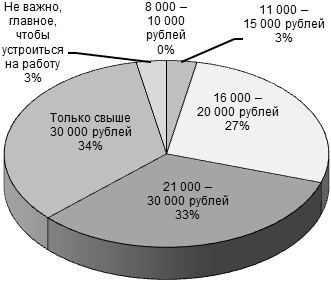
Fig. 1. Desired salary level. Graduate survey data, 2012/13 academic year
At the same time, responses to the question of whether graduates intended to work in the profession for which they had trained showed the following trends (Fig. 2).
For comparison, let us look at the actual employment picture for graduates, data on which are regularly collected by the Service and analyzed in order to improve its work. Statistics show that around three quarters of graduates nevertheless decide to continue along the professional path they chose when entering college. Even those who decide to continue their education generally do so in the specialty chosen at college and enroll in specialized universities with which the college has agreements.
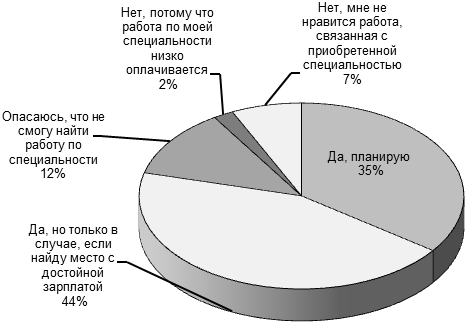
Fig. 2. Graduates’ plans regarding future employment in their specialty, 2012/13 academic year
By the end of the 2012/13 academic year, there were nine such universities, including such well-known institutions as Stankin University, National Research University MPEI, and Moscow State Technical University of Radio Engineering, Electronics and Automation.
The results obtained (Fig. 3) demonstrate the importance of this work and set new tasks for us. One of the most important areas of the Service’s work planned for development in the near future is the creation of a CAIT No. 20 alumni community similar to student alumni clubs at leading foreign universities. We see the community’s tasks as actively involving students in planning their professional future through communication and exchange of experience with the most successful graduates of previous years; promoting the community’s ideas through a mandatory presence in electronic media, including the college’s official website; and other initiatives.
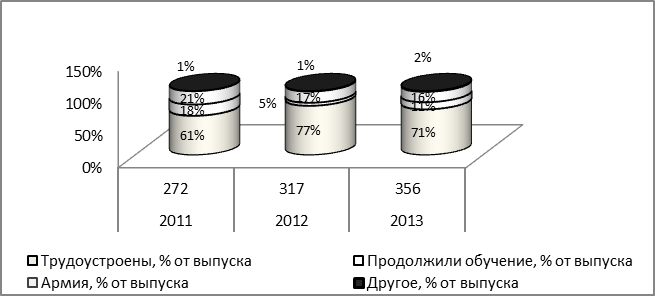
Fig. 3
Another promising direction is to expand the Service and transform it into a Resource Center for Graduate Employment Support operating on a territorial and/or sectoral basis for personnel selection and training. One means of implementing this idea could be the creation of a student recruitment agency in which the main functions would also be assigned to the students themselves, helping them develop communication and management competencies.
Another possibility is to involve students studying Advertising and Design — including those working in the student advertising agency — as well as the college’s employer partners in these industries in developing a kind of advertising campaign, or “rebranding,” for the specialties and professions taught by the college.
Since the customers of the college’s educational services are not only students and adult learners but also employers, one of the most important prospective areas of the Graduate Employment Support Service’s work is the “fine-tuning” of the educational process to meet the needs of this group. Two leading directions can be identified here: targeted marketing research into the needs of employers that are important both to the college itself and to the regional labor market, and active involvement of employers in joint work to modify and enrich the content of specialized subjects in the college curriculum. We see this activity exclusively as cooperation with the college’s methodological service, which plays a key role in organizing support for the educational process.
Thus, at present we see that vocational education at all levels faces a number of problems that objectively complicate the employment of graduates. These include the still insufficient level of preparation of young professionals, linked both to the slow and difficult development of educational programs and their reorientation toward market demands, and to the readiness of teaching staff themselves, who are also forced to seriously reconsider familiar technologies and standards of work so that the final product — a graduate with a certain level of preparation — is in demand in the labor market.
Another issue is the persistence in public consciousness of familiar stereotypes about the prestige and earning potential of professions and about the prestige and quality of particular levels of education, which distort perceptions of demand for different occupations and specialties. In our initial experience, this also affected employers’ attitudes toward graduates of the secondary vocational education system. Only painstaking work to create a positive image of the college in the eyes of social partners, greater openness and transparency of the specialist-training process for employers, and, of course, positive experience of cooperation in employing college graduates made it possible to build a certain level of mutual trust and establish stable relationships.
A serious problem remains the introduction into the practice of the college and, in particular, the Graduate Employment Support Service of a number of business technologies, such as regular labor-market marketing research focused on the “target segment” of employers. A number of research institutions in Moscow education and organizations subordinate to the Moscow Department of Labor and Employment have conducted such studies through electronic surveys of employers, including those with which the college cooperates. We have also attempted to conduct informal surveys of social partners in order to improve the work of the training-and-production service and the Graduate Employment Support Service. However, despite established positive relationships, we still often encounter a superficial and formal attitude toward such surveys. It may be necessary to cooperate more actively with government authorities on this issue and secure their support in carrying out research. In turn, using their status and powers, these authorities are better positioned to conduct informational and motivational work with employer representatives to encourage an interested and non-formal approach to such studies.
A separate problem is student motivation, which is also multifaceted. On the one hand, it concerns developing a clear and stable motivation among students to continue along their chosen professional path. This cannot be achieved without additional, in-depth career guidance carried out in close cooperation with psychologists. On the other hand, it concerns increasing the motivation of students and graduates to contact the Graduate Employment Support Service when looking for work. Not all of them approach the Service in good time; some postpone job seeking until the end of the academic year, when the number of vacancies is at its highest. This subsequently makes the job search more difficult for them.
Despite the existing difficulties, however, the Service’s experience as a whole demonstrates that this work is in demand among all the groups with which the college interacts: students and graduates, their parents, who also sometimes seek assistance, and employers.
References
- Letter of the Ministry of Education and Science of the Russian Federation dated January 18, 2010, No. IK-35/03 “On the Establishment and Operation of Centers (Services) for Promoting the Employment of Graduates of Vocational Education Institutions.”
- Young Specialist. State Policy, Education, and the Country’s Production Sector: Proceedings of the All-Russian Conference / M. N. Nazarova, ed.; Siberian Federal University. Krasnoyarsk, 2010. 121 pp.
- Encyclopedia of Employment Support. Vol. 12. Practices of the Best Centers (Services) for Promoting the Employment of Graduates of Vocational Education Institutions / Editor-in-Chief
E. P. Ilyasov. Moscow: KCST, 2011. 514 pp. - Encyclopedia of Employment Support. Vol. 14. System for Promoting the Employment of Graduates of Vocational Education Institutions: Organization and Operation / Editor-in-Chief E. P. Ilyasov. Moscow: KCST, 2013. 200 pp.
Online Resources
- Excerpts from the United Nations Development Programme report on human development in the regions of Russia for 2013 / Center for Humanitarian Technologies.
- Universitas 21: Ranking of National Higher Education Systems 2012 [Electronic resource] / Center for Humanitarian Technologies.
- Hays and Oxford Economics Study: Global Skilled Professionals Index 2013 [Electronic resource] / Center for Humanitarian Technologies.
- Levada Center Study: Russians on the Quality of Education in 2013 [Electronic resource] / Center for Humanitarian Technologies.
- VCIOM Study: Russians on Higher and Secondary Vocational Education in 2013 [Electronic resource] / Center for Humanitarian Technologies.
- VCIOM Study: Ranking of Prestigious and High-Earning Professions among Russians in 2012 [Electronic resource] / Center for Humanitarian Technologies.
- PricewaterhouseCoopers Study: HR Barometer 2013 [Electronic resource] / Center for Humanitarian Technologies.
- Employee Knowledge and Skills Shortages: Are HR Departments Ready? [Electronic resource] / Trainings.ru