



Most of us have probably experienced a state in which something is happening to us, but we cannot understand why. We can describe it in different ways: “I feel anxious”, “I’m angry”, “I feel bad”, but it is obvious that things are not that simple. Behind this there may be fear, hurt, irritation, confusion — sometimes several different feelings or all of them at once, and it is not easy to make sense of this tangle.
Sometimes it is much easier not to try to describe our state, but to try to depict it. It might be a tangled mass of lines, a dark blot, a strange shape, or a combination of several colors that for some reason we feel like using together. There is no need to draw beautifully: what matters is not the result, but the possibility of expressing something for which words are not enough.
This simple idea lies at the heart of one approach in art therapy — working through drawing. But how did psychologists come to the idea of using a creative visual approach to help people, and who first called this approach art therapy? The method has an interesting history...
From the Hospital Ward to Psychotherapy: How Art Therapy Emerged
 The history of art therapy did not begin with a psychological experiment or in a psychotherapist’s office. One of the people who helped give the approach its name was the British artist Adrian Hill (Adrian Keith Graham Hill). In 1938 he contracted tuberculosis and spent a long period receiving treatment in a sanatorium. At that time, such treatment could last for months, and patients had to spend a considerable part of their time in bed. Hill began drawing what he saw around him. Gradually, he realized that this activity did more than simply help pass the time. While drawing, it became easier to take his mind off the illness and anxious thoughts and to escape the monotony of hospital life.
Later, Hill began drawing with other people. He was interested less in teaching painting than in the state people experienced while engaged in creative work. Someone who had been in hospital for a long time could, at least for a while, stop feeling like nothing more than a patient and do something that required attention, imagination, and personal choice. Hill became increasingly convinced that art could play a role in a person’s recovery. In 1942 he proposed the name art therapy for this form of creative work.
However, it would be wrong to say that art therapy was invented by just one person. Around the same time, similar ideas were actively developing in the United States, although the approach was somewhat different. One of the central figures was psychologist and educator Margaret Naumburg. Above all, she was interested in the possibility of expressing through drawing what was difficult or impossible to describe in words.
Naumburg regarded spontaneous drawings almost as a special visual language. She encouraged clients to draw freely, without trying to make the image correct or beautiful, and then to reflect on what had emerged and what associations it evoked. What mattered was not that the psychologist should try to “decode” the picture at any cost, but what meaning the person who created it discovered in it. Drawing became a way of reaching experiences, inner conflicts, and memories that were difficult to explain verbally.
Later, another artist and art therapist, Edith Kramer, had a major influence on the development of this field. Here an interesting distinction emerged that clearly shows why art therapy became much broader than the simple interpretation of drawings. In Naumburg’s approach, the image mainly supported psychotherapeutic work — it could provide access to experiences that could then be discussed — whereas Kramer placed much greater emphasis on the value of the creative process itself. For her, what mattered was what happens to us while we draw, model, choose materials, adjust an image, and gradually turn our inner state into a visual form created with our own hands.
Thus, two closely related but somewhat different views of the process emerged. In one, art becomes a kind of bridge to a conversation about the inner world; in the other, the creative process itself is regarded as part of therapy. Over time, these ideas developed together and grew into an entire field. Art therapy gradually moved beyond individual hospitals and the experiments of enthusiasts; professional associations, training programs, and numerous methods of practice appeared.
But this leads to the next, and perhaps most interesting, question. Why can a few lines on paper, patches of paint, or a drawn image help us better understand our inner experiences at all? Let us now look at what happens when an inner state takes on form and color and appears before us on a sheet of paper.
What Happens When a Person Puts Their Feelings on Paper
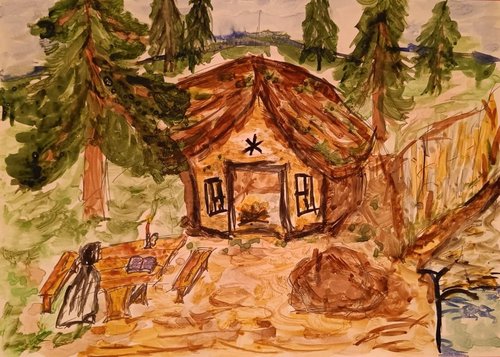 As already mentioned, an inner state can sometimes be difficult to describe in words or even to understand ourselves. The reasons for our anxiety, tension, or irritation may remain vague and unclear. An inner experience can feel like a heavy lump that we cannot get rid of.
In this sense, drawing allows us to do something quite simple and important — to bring part of an inexplicable experience outside ourselves. What previously existed only as a sensation acquires form, outlines, and colors on paper. Anxiety, for example, may turn into a tangled mass of lines, loneliness into a small figure in the middle of a large empty space, and intense inner tension into some incomprehensible abstract image. Sometimes we simply feel like shading the entire sheet, moving the pencil back and forth over it again and again.
When the experience is in front of our eyes, we can look at it from the outside. We may notice how enormous the troubling image is, where we place ourselves in relation to other figures or images, which colors we chose, what we wanted to hide, and what, on the contrary, we brought to the foreground.
Some details may even surprise the person who made the drawing. For example, while depicting a conflict, we may notice that we drew ourselves far away from everyone else, made one figure much larger than another, or placed some obstacle between them. None of this proves anything by itself, but it gives us a reason to wonder: why did we depict it exactly this way, and what does it mean personally to us?
But it is very easy here to fall into a trap and start treating the drawing as a set of secret signs that the psychologist must correctly decipher. Art therapy does not work that way at all! We cannot state in advance that red always means aggression, that a tree necessarily has something to do with parents, or that a small door indicates some psychological problem.
The same image can have completely different meanings for different people. For one person, black may be associated with fear; for another, with calm; for a third, it may simply be a favorite color. Even the same person can give the same images completely different meanings at different periods of life.
That is why in art therapy the more important question is not “What does this symbol mean?”, but questions of a very different kind: “What does it mean specifically to me?”, “Why did I want to draw it this particular way?”, “What do I feel when I look at this drawing?”, “Do I want to change anything in it?”
This is where an important boundary lies between art therapy and the many online tests of the “draw a house, a tree, or a person — and we will tell you everything about yourself” variety. In art therapy, a drawing does not provide a ready-made diagnosis or automatically reveal some hidden truth. Rather, it creates an opportunity to look more closely at our own experiences and begin thinking about things that would be difficult to notice or describe in words.
What Happens in a Session: Do You Need to Know How to Draw and What Do You Actually Do?
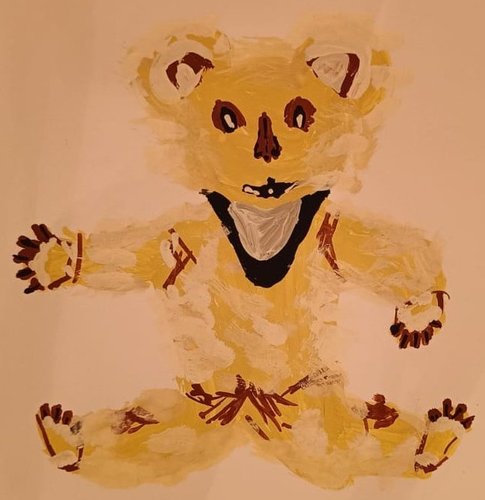 One of the first questions that usually comes up when drawing-based art therapy is mentioned is: “But what if I cannot draw at all?” In truth, it hardly matters. During a session, no one will judge how correctly we have drawn a person, whether the house looks realistic, or whether we understand perspective. No — here the drawing serves a different purpose.
The session itself can be structured in all sorts of unexpected ways. Sometimes the psychologist suggests a specific theme, sometimes offers several options to choose from, and sometimes simply invites us to take pencils, markers, or paints and begin drawing whatever feels right at that moment.
For example, one of the simplest tasks is to depict your current state. You do not have to draw yourself. You can choose several colors, draw lines and shapes, or fill the page with patches of arbitrary size. Inner tension and mental confusion may turn on paper into a dense knot of intersecting lines. If you feel tired, empty space, muted colors, or barely visible strokes may appear in the drawing. But there are no preset rules: everyone depicts their inner world in their own way.
Another possible task is to draw anxiety, fear, anger, or another intense experience. The psychologist may suggest imagining what it would look like if it had a shape, size, and color. Where would it be on the page? Would it be huge or small? Would it have clear boundaries or spread out in different directions? The very process of searching for an image already makes us think about what we feel.
Sometimes people are invited to draw a safe place — real or imaginary. It might be a childhood home, the seashore, a forest, a room with a closed door, or some fantastic place that does not exist in reality. After the drawing is made, one can discuss what might make this place safe, who could be nearby, what should not be there, and what one would like to add. This task is also interesting because it helps us understand what the feeling of calm and safety is personally connected with for us.
Another major topic is relationships with other people. We can try drawing ourselves and family members, ourselves and a partner, colleagues, friends, or the people involved in a conflict. Sometimes very simple details turn out to matter: who is placed where, how far the figures are from one another, who takes up more space, between whom a boundary has been drawn, and who ended up outside the picture.
Imagine, for example, that we are depicting a conflict at work and draw ourselves as a tiny figure in one corner of the page, while the boss is enormous and takes up almost the entire space. The psychologist will not claim that this necessarily means fear of authority or some psychological problem. More likely, they will ask a series of questions: “Why did you draw yourself at exactly this size?”, “How does the boss seem to you in this drawing?”, “What do you feel when you look at these two figures?”, “What would change if your figure became larger?”
Sometimes, instead of people, the task is to depict the problem itself. For example, anxiety can be drawn as a wall, a difficult life situation as a maze, and a conflict as two figures with a rope stretched between them. Then the drawing can be changed: add an exit from the maze, make the wall lower, draw a door, loosen the rope, or add something nearby that helps with the situation. Of course, this does not mean that changing the picture will magically make the real problem disappear. But the technique makes it possible to experiment with the image of the situation and imagine explanations of its causes that may never have occurred to us before.
A completely free form of work is also possible, with no theme set in advance. You can start with a blot, a random line, or a color and see what the image gradually turns into. Sometimes a recognizable image emerges while drawing; sometimes the picture remains abstract. Both are perfectly normal. The value may lie in the process itself — in the opportunity, for a while, not to search for the right visual description and not to try to control the result in advance.
Another interesting option is to draw the same state twice. First as it feels now, and then as you would like it to feel. For example, in the first drawing a person depicts themselves trapped in a small dark space, and in the second adds a window, a door, or someone nearby. Comparing the two images can become a starting point for discussing what is missing now and what changes one would like to see not only on paper but also in real life.
Work does not have to be done only with pencils. Some people prefer markers with clear lines; others prefer paints that allow colors to be mixed and large areas to be filled. Someone may want to use charcoal, pastels, or wax crayons. Even the choice of material can become part of the process: today you may want to draw everything carefully with a fine pencil, while another time you may prefer a broad brush and not care about the precision of the lines.
It should be noted that the work usually does not end when the drawing is finished. Often, the most interesting part begins afterward. The psychologist invites us to look at the image, describe what is happening in it, which details seem especially important, what we like, what evokes unpleasant feelings, and whether we want to change anything. Sometimes we ourselves are surprised by what we have drawn or discover a connection we had not thought about before.
Sometimes the desire to make a drawing beautiful can get in the way. If we are constantly thinking about whether the line is straight, whether the color is right, and whether others will like the result, our attention shifts from our own experiences to the quality of the picture. In art therapy, it is perfectly acceptable to draw unevenly, strangely, carelessly, and quite unlike the way we would draw something “for display.”
The goal of such a session is not to go home with a beautiful picture. Much more important is whether the drawing helped express something that previously had no words, notice something about our own state, or look at a familiar situation from a little distance.
When Drawing Can Really Help — and What Not to Expect from Art Therapy
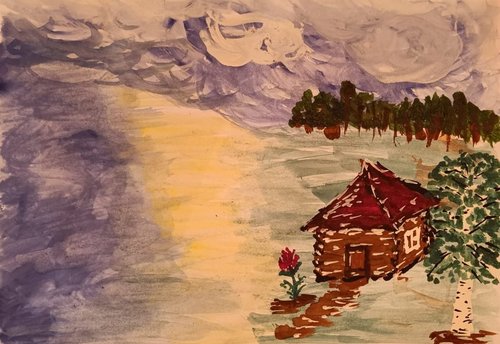 A natural question arises: in what situations does it make sense to work with drawing if problems can simply be discussed with a psychologist? In reality, one does not exclude the other. Drawing can be extremely useful when conversation alone is not enough.
Imagine that anxiety has been with us for a long time. We are constantly afraid that something may happen, repeatedly run possible troubles through our minds, feel persistent tension, but cannot understand the reasons for it and therefore cannot really try to deal with the problem. Talking can, of course, also help us understand what is happening, but drawing provides an additional way to explore this state. Sometimes it is easier to depict anxiety first and only then move on to discussing it.
This approach can be especially useful when working with children. A child often finds it difficult to describe in detail the reasons for fears, hurt feelings, or avoidance of certain life situations. This does not necessarily mean that the child does not want to talk: they may simply lack the words to describe complex experiences. In that case, drawing becomes another form of communication. This certainly does not mean that a psychologist can merely look at a picture and immediately understand everything that is happening with the child. But the image can provide useful material for the conversation ahead, suggest important questions, and help determine the direction of further work. Research on art therapy with children and adolescents does indeed show positive results, particularly for anxiety, although the effectiveness and quality of evidence vary across studies.
Drawing can also be helpful when we are experiencing a loss, a serious conflict, a breakup, or another event that is very difficult to talk about. Sometimes the problem is not even that we cannot find the words. We may be able to describe exactly what happened, name dates, list the sequence of events and other people’s actions, yet still avoid touching on our own feelings. In such a case, a visual image may allow us to approach the experience from a new angle.
Some people are more accustomed to analyzing everything than to turning toward their own feelings. They can explain the causes of a conflict in great detail, describe the mistakes made by everyone involved, and say exactly what should have been done differently. The result is almost a perfect analytical report, while their own feelings remain outside the frame. Being asked to draw the same situation may at first seem strange or even pointless, but precisely the absence of the need to construct a logical explanation can reveal something that is missing from familiar reasoning.
At the same time, it is important not to turn art therapy into a universal method that supposedly works in every situation and solves every psychological problem. Drawing may genuinely help one person express their experiences freely; another may find it easier to talk; a third may feel more comfortable with movement, music, or other creative forms. Even if a method has proved useful in certain areas, that does not mean it will necessarily suit everyone.
There is another important point. Taking pencils in the evening, drawing for half an hour, and feeling calmer afterward is a wonderful thing, but it does not mean that we have conducted an art therapy session on ourselves. Drawing independently can help us switch our attention, reduce tension, or simply enjoy creative work. None of that requires a psychologist.
Professional art therapy works differently. It involves not only the drawing itself, but also the relationship between client and specialist, an understanding of psychological processes, the selection of appropriate methods, and subsequent discussion of what happened during the work. That is why professional organizations regard art therapy as an approach to improving psychological well-being that combines the creative process, psychological theory, and the psychotherapeutic relationship — not simply as an activity involving drawing.
We should not expect a drawing to reveal some carefully hidden secret of our subconscious either. Sometimes an image really does unexpectedly lead us to an important thought; at other times it remains simply a drawing that reveals nothing remarkable. That is normal too. The aim of art therapy is not to discover a hidden psychological meaning in every color or line.
Perhaps this is precisely why the value of drawing in psychotherapy does not lie in a psychologist’s ability to see something in it that we ourselves do not know about ourselves. Something else is far more interesting: sometimes, through a few lines, colors, and images, we can for the first time see in front of us something that had previously existed somewhere inside — as a vague feeling, anxiety, or inner tension. And when the experience becomes clearer to us, it becomes much easier to talk about it with a specialist.