


 Some subjects frighten us and attract us at the same time. Serial killers, murderers, psychopaths... They seem to belong to another, darker world where different rules apply. We read articles, watch films and documentaries, wondering: how can someone lead an ordinary life — go to work, smile at the neighbors — and then kill in cold blood? What is going on inside their mind? Why did they become this way? Our interest is not merely idle curiosity. In a sense, it is an attempt to reassure ourselves: if we understand why someone became a monster, perhaps we can find a way to prevent new tragedies. Or maybe it is even simpler — we are afraid of what we do not understand. And that is precisely why we want to look inside...
Select your language

Articles
 For many people, the word “exam” brings up anything but pleasant associations. Even years after finishing school or university, simply hearing the word can make something tighten inside. Some remember staying awake all night before an important test. Others remember standing outside the exam room with trembling hands. And some remember forgetting everything they knew at the very moment they had to answer. Why does this happen? After all, an exam is essentially just a way of assessing knowledge. Yet in real life it often turns into a genuine psychological duel — with ourselves, with expectations, with the past. Sometimes we are not afraid of the task itself, but of what stands behind it: the fear of making a mistake, the feeling of shame, the expectation of failure. In this article, we will look at what exactly makes exams so stressful, where these emotions come from, and how we can learn to cope with them...
 Imagine a teenager or an adult who knows exactly what they want from life. They dream of becoming an architect, psychologist, or programmer. Their eyes light up, their interest is genuine, and their ambitions feel strong and meaningful. Then comes the moment of taking career guidance tests — and the result is discouraging. Their chosen profession is nowhere to be found among the recommendations. Worse still, the tests say: “You have low aptitude in this area” or “Your inclinations point in a completely different direction.” This creates an inner conflict. What should you do? Accept the results and give up on the dream? Or, on the contrary, ignore the test and push ahead, even if the path turns out to be harder than expected? Can career guidance really “know better” what suits a person? And how can you tell where realism ends and self-sabotage begins, where reasonable reassessment turns into betraying your own aspirations? This article is for those who find themselves at a crossroads between a dream and a test result...
 Everyone knows the feeling: you get up in the morning, turn on the tap — and your hand automatically reaches for warm water. A cold shower feels like torture, snow under bare feet like madness, and the thought of stepping into icy water can make you shiver with fear. Why? What makes us recoil from the cold and avoid even the idea of deliberate cold exposure? Part of the answer lies in psychology. Cold is perceived as stress not only by the body, but also by the mind. Instinctively, we associate it with danger, vulnerability, and discomfort. In a modern world where warmth, comfort, and predictability have become the norm, almost any step beyond that comfort zone can feel threatening. Cold exposure is more than a physical procedure. It is an encounter with inner resistance, a test of the limits of our will, and a way of training our ability to face discomfort...
 Every night we fall asleep hoping simply to rest and recover. But what if sleep is more than rest — and plays a key role in our mental health? And what if, in depression, it can become not merely a source of support but an important part of treatment? Depression is one of the most common mental disorders in the world. According to the WHO, many people experience symptoms such as low energy, loss of interest in life, anxiety, and sleep disturbances. Sleep problems in particular are often seen simply as a consequence of depression rather than as a factor that can also contribute to its development and persistence. But recent research suggests that the relationship works in both directions...
 At first glance, superstitions may seem like a relic of distant times, when people explained mysterious phenomena through magic and myths. It might seem that today, in an age of technology and science, such beliefs should have disappeared. Yet they remain alive — in the small rituals, habits, and fears that accompany our everyday lives: some people avoid crossing paths with a black cat, some knock on wood so as not to “jinx” their luck, and others are still afraid of the number 13. Why do rational people continue to see signs of fate in random events? How do superstitions arise, what psychological mechanisms lie behind them, and what role do they play in our lives? In this article, we will try to understand what lies behind this seemingly “harmless” belief in signs and omens — and just how deeply these phenomena are rooted in the nature of human thinking...
 “There’s no time” is one of the most common complaints in the modern world. We feel rushed, exhausted, and constantly behind our own schedules. Even a day off often turns not into rest, but into an endless list of things we “should” do. And the more digital assistants, reminders, and to-do lists we have, the more anxious we seem to become. But what is the real problem? Time passes at the same rate for everyone. We all have 24 hours in a day. Yet some people manage to maintain balance, deal calmly with important tasks, and still live “on their own terms,” while others drown in deadlines, procrastination, and guilt. Why? The answer often lies not in the number of tasks, but in the psychology of our relationship with time. We do not simply plan — we experience. We do not simply put things off — we worry. We do not simply set goals — we often devalue ourselves when we fail to keep up...
 Rumination is the repetitive dwelling on the same thoughts, usually negative ones. A person keeps replaying past mistakes, worrying about possible scenarios or focusing on personal flaws, but instead of finding a real solution, becomes stuck in the same mental loop. This often occurs with anxiety, depression, and stress. Unlike productive reflection, rumination does not lead to useful conclusions and may only worsen a person’s emotional state. If you find yourself caught in this pattern, you can try shifting your attention through exercise or hobbies, practicing mindfulness, or writing your thoughts down to see more clearly when they are going nowhere. Rumination is not a weakness or a “bad habit,” but a psychological mechanism that can be brought under greater control. A combination of mindfulness, action, and support can help break the cycle of repetitive thoughts and restore a sense of engagement with life...
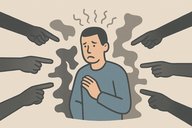 Othering (from other) is the psychological or social process of separating and opposing “us” and “them.” It occurs when a group or individual is perceived as foreign, different, abnormal, or “other” and, as a result, as less important, unequal, or sometimes even dangerous. There is no single universally accepted equivalent for the term othering in Russian, but several expressions are commonly used: stigmatization — emphasizing the assignment of negative labels; enemy image — when discussing politics or conflict; alienation — emphasizing social separation; designation of the “other” — the closest literal rendering; exclusion of “outsiders” — often used in social and ethnocultural contexts; and drugovanie (“othering”) — a neologism sometimes encountered in academic circles and blogs as an attempt to create a precise Russian equivalent of the English term...