



3.Theoretical Foundations
3.1.Main Types of Tests
Sindy can be used to create a wide variety of tests. Each test is defined by a set of standard objects that determine the test structure and its behavior after launch. In general, a test consists of lists of questions and related answers from which the test taker selects the most appropriate options. Other test objects, including scales, interpretations, and weights, define the mechanism for calculating test results.
Additional settings can be defined for any test and question to adapt the testing process to specific conditions. These additional settings include:
- The direction of movement through test questions can be set to one of the following options:
- Forward sequentially through the test questions (all questions are displayed in strict sequence according to the order established when the test was constructed)
- Forward and backward sequentially through the test questions (all questions are displayed in strict sequence according to the order established when the test was constructed, but it is also possible to return from the current question to previous questions)
- Free navigation to any test question (it is possible to jump directly to any question from the available list of questions)
- Previously displayed test questions can be allowed to repeat or repetition can be prohibited during testing
- Selection of more than one answer for a particular question can be allowed or prohibited during testing
- The test taker can be required to select at least one answer for every question during testing
3.2.Principles of Test Construction
To use Sindy effectively, it is necessary to understand the basic principles of test construction, which are quite simple. Test objects are related as follows:
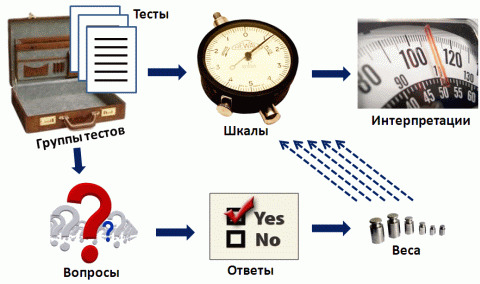
All tests are organized into user-created groups to make it easier to work with large numbers of tests. Any group can contain any number of tests.
Each test must contain questions, which are then shown to respondents during testing according to the principle of one question per screen. Any number of answers can be associated with each question, and the test taker selects from them when answering the question.
Weights (or weight values) are assigned to answers and determine the degree to which a particular answer affects the final result on a predefined scale.
Any test can have one or more scales reflecting individual characteristics whose combination is identified during testing. For example, you can develop a comprehensive physics entrance examination for admission to a higher education institution, with scales such as “General Physics”, “Electromagnetic Phenomena”, “Nuclear Physics”, etc. The test results would then be the scores obtained on each scale.
For automated evaluation of test results, interpretations must be defined. An interpretation is a standard statement or description selected when a test result falls within a predefined portion of the range of possible values on a scale.
An important feature of Sindy is that a test can be developed in which any answer affects different test scales with different weights. This is achieved by creating several weights that directly link such answers and scales. Thus, more than one weight value can be associated with an answer, but no more than the number of scales in the test.